

Life in GainesvilleBlog
What's in our water? We started with lead
Week one of our new series: the latest lead test for all 19 public water systems in Cooke County, side by side.
· 3 min read · 0 views
Most of us fill a glass at the kitchen sink without a second thought. This winter we're giving it one. Each week in our new series, What's in Our Water?, we take one thing Texas tests for in drinking water and show where every public water system in Cooke County stands. Week one is lead.
We read the lead test records the Texas Commission on Environmental Quality keeps for all 19 public water systems in the county, from the City of Gainesville down to subdivisions of about 130 people. Together they serve about 43,000 people. Then we checked the latest results against EPA's own records. They matched.
Every system is under the limit
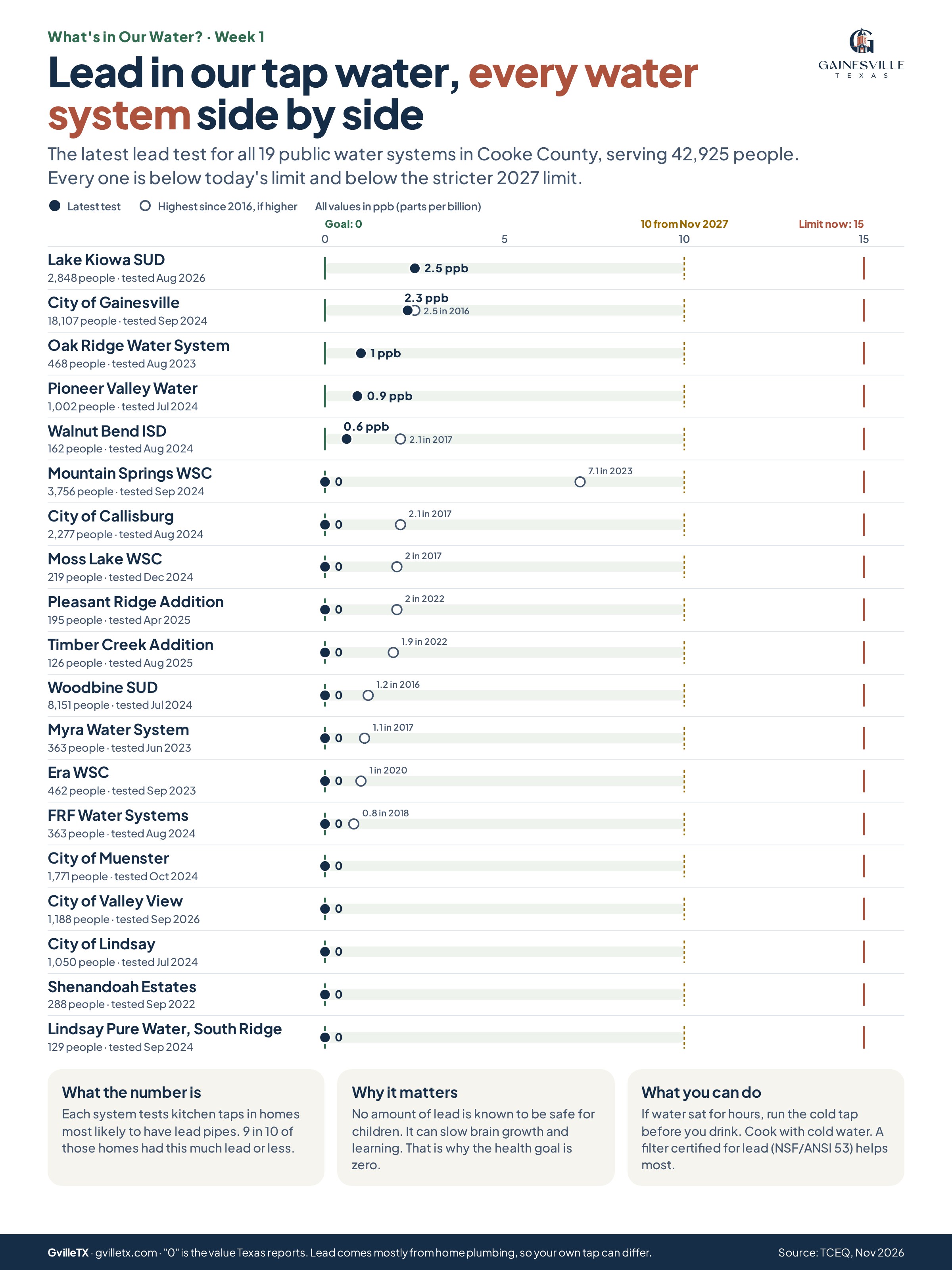
Every system's latest result is below the federal action level of 15 parts per billion (ppb). Every one is also below 10 ppb, the stricter level that takes effect in November 2027. Fourteen of the 19 reported 0 in their latest round. The chart also shows each system's highest result in the last 10 years. None of those reached 10 ppb either.
GvilleTX
Lake Kiowa SUD has the highest latest result, 2.5 ppb from August 2026. Its two rounds before that came back 0. The City of Gainesville, the largest system, came in at 2.3 ppb in September 2024. Its results have stayed between 1.1 and 2.9 ppb in every round since 2007.
The highest round in the county's records since 2007 was Mountain Springs WSC: 7.1 ppb in September 2023. Its next round, in September 2024, came back 0.
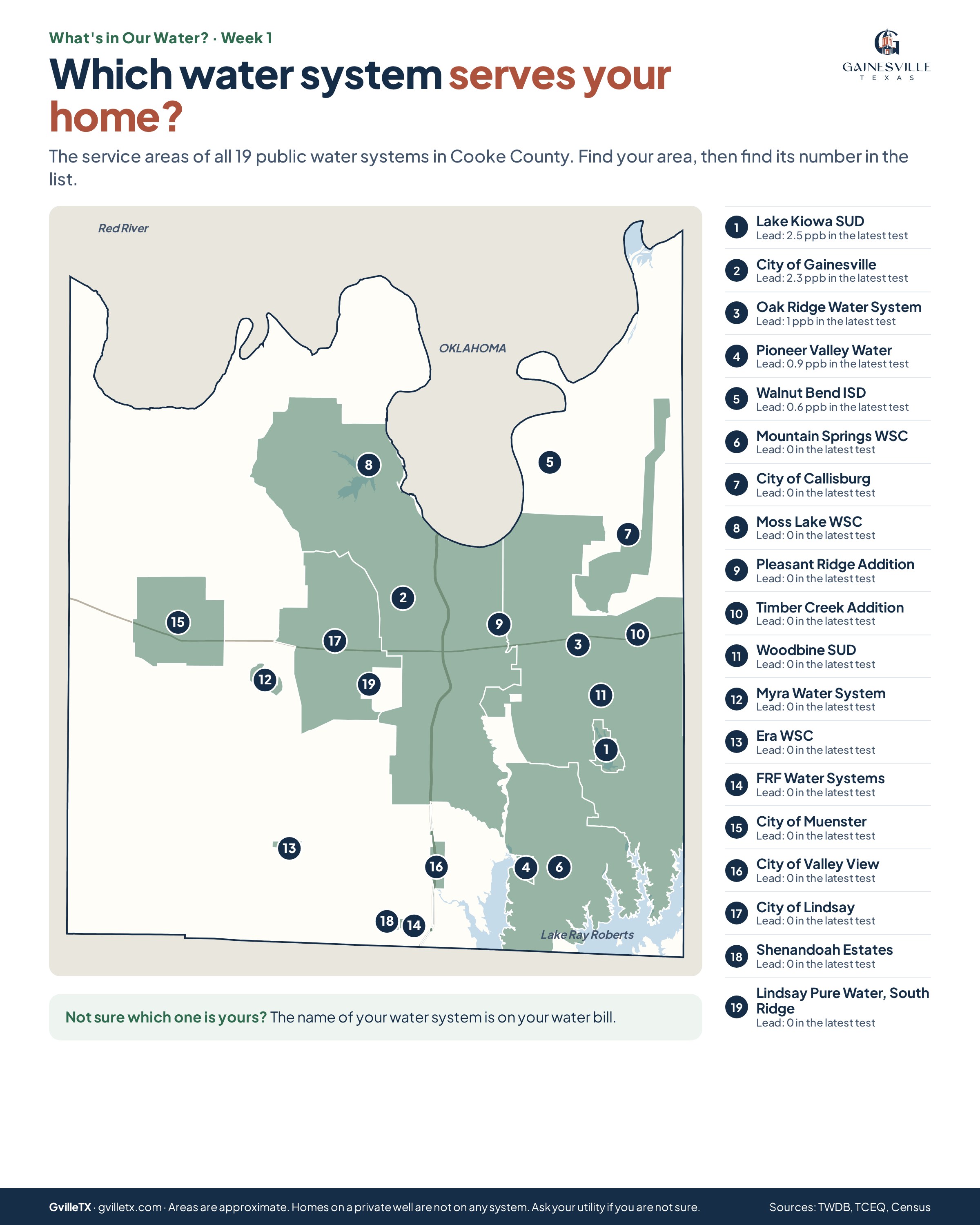
Not sure which system serves your home? This map shows the area each one serves. The name of your system is also on your water bill.
What the number means
Lead rarely comes from the lake or the well. It comes from lead pipes, old solder and brass fixtures between the water main and your glass. So utilities test the taps in homes most likely to have that plumbing, using water that sat in the pipes for at least six hours.
The number each system reports is the 90th percentile: nine of every ten homes tested had that much lead or less. Your own tap can be higher or lower than your system's number, because it depends on your plumbing.
No amount of lead is known to be safe for children, so EPA's health goal is zero. The 15 ppb action level is not a safety line. It is the point where a utility must act: treat the water so it is less likely to eat at pipes, tell customers and replace lead pipes.
A few more things in the records
Since 2007, five single home taps came back above 15 ppb, three in the City of Gainesville and one each in Callisburg and Mountain Springs WSC. Each time, the 90th percentile stayed under the limit, so no action was required.
Seven systems missed the October 2024 deadline to publish their list of lead and non-lead service lines. All seven had it done between April and June 2025.
What you can do at home
If water sat in your pipes for hours, run the cold tap until it feels colder before you drink or cook with it. Use cold water for drinking, cooking and baby formula, because hot water picks up more lead. A filter certified to NSF/ANSI Standard 53 for lead removes most of it. And you can ask your water utility whether the line to your house is lead. Each system has to keep that list.
Next week: copper.
Sources
- Texas Commission on Environmental Quality, Texas Drinking Water Viewer, lead and copper summaries for each public water system in Cooke County, read Nov. 23, 2026: dwv.tceq.texas.gov
- U.S. Environmental Protection Agency, Safe Drinking Water Information System, lead and copper results and violation records: data.epa.gov
- U.S. Environmental Protection Agency, Lead and Copper Rule Improvements, final rule of October 2024: www.epa.gov/ground-water-and-drinking-water/lead-and-copper-rule-improvements