

Update, Aug. 10, 2026: On the afternoon of Aug. 10, the Cooke County Sheriff's Office issued its first public statement on the Flock program and published an ALPR use policy and a transparency portal disclosing the camera count (16), the retention period (30 days) and its sharing lists. Passages below describing those facts as undisclosed reflect the record as of this article's publication on July 28. [Read our full report on the statement and the new disclosures.](https://gvilletx.com/news/sheriff-sappington-flock-cameras-first-statement)
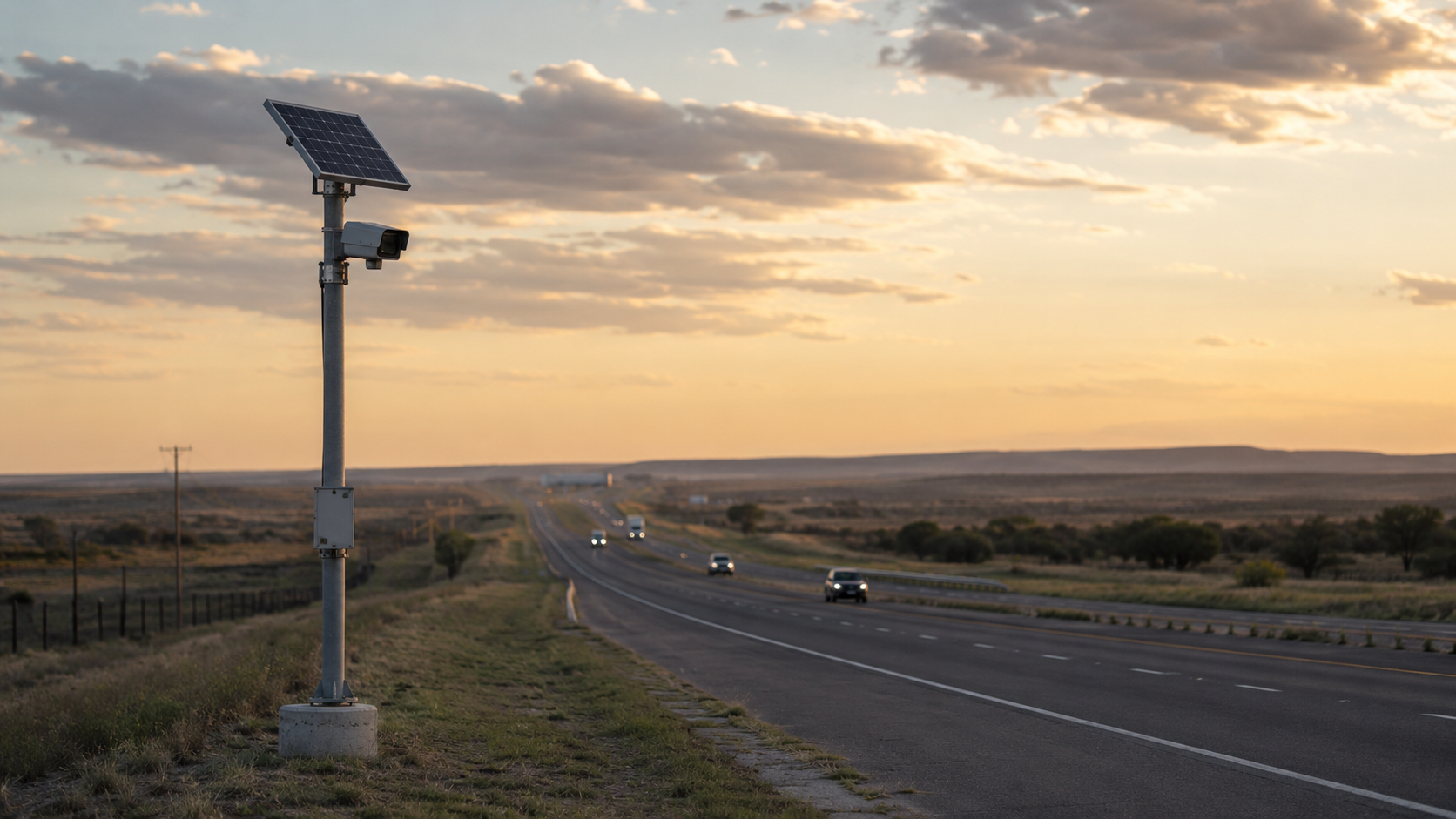
They sit on poles along I-35 between Gainesville and the Red River, on US 82 at Lindsay, on the interstate at Valley View: small cameras built to photograph passing vehicles. Volunteers who map the devices for a national project called DeFlock had logged roughly 22 of them inside Cooke County by early July. Residents have been posting about them on Facebook since at least May. No public explanation from an official could be located.
County records answer part of that. The Cooke County Sheriff's Office joined Flock Safety's license plate reader system through two commissioners court consent agenda items in 2025. County check registers show four payments to Flock Group Inc since June 2025, totaling $83,550, including $12,993 paid from the sheriff's drug-forfeiture fund. No Cooke County agency publishes a Flock transparency portal, and the camera count, the retention period, the rules for searching the data and the question of federal access to it are all publicly undisclosed. No public statement about the program from the sheriff, the county judge or any commissioner could be located, and no prior coverage could be found in four area outlets. GvilleTX reviewed commissioners court agendas, county check registers, budget documents, city council agendas and Flock's own disclosure pages.
The program's first appearance in the reviewed records is the Feb. 10, 2025, commissioners court agenda, on the consent agenda as item 6.L. Approved as part of the consent agenda, it authorized "allowing the County Judge to sign a contract with Flock Safety to provide high speed vehicle license plate recognition cameras and equipment to the Cooke County Sheriff's Department for use in crime detection and prevention- Judge John O. Roane." A second, nearly identical item appears on the Sept. 8, 2025, consent agenda, item 7.Q. The agenda does not say whether that item was a renewal or an expansion. A consent agenda bundles items into a single vote. The posted agendas record no individual discussion of either Flock item, and minutes are not posted on the county website, so the vote breakdown could not be reviewed.
Payments began months later. A review of every posted weekly check register from January 2024 through July 2026 found no Flock payment before June 2025. The June 23, 2025, check register lists $4,250, described as "FLOCK SAFETY LPR FLEX." The Jan. 12, 2026, register lists $24,100 for "FLOCK SAFETY LONG-RANGE." The March 23, 2026, register lists another $24,000, also marked "LONG RANGE." The April 27, 2026, register lists $31,200 for a "FLOCK SAFETY BUNDLE." In the county's FY26 proposed budget, department 560 is the Sheriff's Office and fund 058 is labeled "SO DRUG FORFEITURE." The check registers show $12,993 of the $83,550 was paid from that forfeiture fund rather than the general fund.
Cooke County payments to Flock Group Inc
Four payments recorded in county check registers since June 2025.
Source: Cooke County check registers
One account those payments ran through does not appear in the county's own budget. Three of the four checks, totaling $66,781, were coded to account 001-560-460, written on the register as rent in the sheriff's office. A line-by-line review of the sheriff's adopted budget for the current fiscal year found no such account. The department's general-fund lines cover salaries, fuel, uniforms, weapons, ammunition, training, subscriptions and two equipment accounts, and none of them is a rent line. Texas law allows a county to spend money only in strict compliance with its adopted budget, with narrow exceptions for emergencies and for transfers between items that are already budgeted. Nothing in the records reviewed shows which amendment created the line or when the court approved it.
The sheriff's office received state vehicle-crime grant money while the program grew, though the award records reviewed do not identify what the money purchased. The same Feb. 10, 2025, consent agenda that authorized the first contract also accepted a $24,376 grant from the Texas Motor Vehicle Crime Prevention Authority, the state body that funds vehicle-theft enforcement, though the agenda does not say what the money was for. Board materials published by the Texas Department of Motor Vehicles show that at its July 18, 2025, meeting the authority awarded the Cooke County Sheriff's Office $66,292 for the 2026 fiscal year. The reviewed records do not show how much of either grant, if any, paid for Flock; the cameras are rented, and rent continues after any grant ends.
The plate readers are not the only surveillance purchase for which GvilleTX could locate no public discussion. The Oct. 28, 2024, check register records check 164732 for $11,190 to Aware Inc., a biometrics software company, described in the county's own ledger as "FACIAL RECOGNITION SUBSC" and charged to the sheriff's subscriptions account. Flock's plate readers do not perform facial recognition, a distinction the company stresses in its public materials. This was a separate subscription from a different vendor. No written policy governing its use, and no commissioners court presentation or vote on it, appears in the records reviewed.
According to Flock, its cameras log license plate, state, time, location and direction. The company says its system also creates a "vehicle fingerprint" that can include make, model, color, bumper stickers, decals, roof racks and damage, making vehicles searchable even without a plate number. Flock says footage is retained 30 days by default. The Atlanta-based company works with more than 5,000 law enforcement agencies and says its network includes more than 120,000 cameras across 49 states, CNN reported in July.
404 Media has reported that agencies choose their sharing settings, that many opt into statewide and national lookup, that searches require no warrant and that one officer's query can sweep every camera shared nationally.
Cooke County's place in that network is visible through another agency's disclosure. The Lewisville Police Department's Flock transparency portal, accessed July 27, lists "Cooke County TX SO" and "Lindsay TX PD" among organizations granted access to Lewisville's camera data, confirming that both hold Flock accounts. The Denton Police Department's portal lists both agencies as well. Cooke County has no equivalent portal. Checks on July 27 found no page for Gainesville police, the Cooke County Sheriff's Office, Lindsay police, Muenster police or Valley View police. Lewisville's portal shows 31 cameras, 30-day retention, 695,165 vehicles detected in the previous 30 days, 504 searches in that period and 7,904 hotlist hits, with hotlists including NCIC and AMBER alerts.
The crowdsourced map is the closest thing to a public accounting of where the cameras stand, and it has limits. It shows clusters on I-35 from Gainesville north to the Red River, cameras in Gainesville itself, at Lindsay on US-82, at Valley View and in the eastern county, but it does not identify which agency operates each device, and some interstate units could belong to the Texas Department of Public Safety. The Texas Observer has reported that DPS holds a $26 million Flock contract, and KUT reported that DPS installed Flock cameras on state rights-of-way in Austin. The mapping project itself has become part of the fight: DeFlock has crowdsourced the locations of more than 76,000 plate readers nationally, NPR reported, and Flock's chief executive called the project "terroristic" in an interview last fall, a label he apologized for in July, a description its founder rejected, saying the volunteers "encourage people to fight mass surveillance legally and respectfully."
Nothing in the reviewed public records shows the city of Gainesville as a buyer. No license plate reader or Flock item appears in any city council agenda from early 2024 through July 2026, including two scanned 2025 agendas reviewed separately, though purchases under bid thresholds would not necessarily appear. The city does disclose other equipment acquisitions: an Oct. 21, 2025, council item authorized the police department to keep participating in a federal surplus program that has supplied it with an armored vehicle and an observation tower, and required the city to notify the public that it may request further controlled property, including night vision, optics and camera sets. Gainesville's police department also does not appear in the Flock data-sharing list reviewed by GvilleTX and has no transparency portal.
Gainesville does have an earlier surveillance record, one that went through named resolutions with recorded votes. On March 5, 2013, the City Council voted 7-0 for Resolution 03-05-2013 B, authorizing a $21,120 grant application to the Governor's Criminal Justice Division for an automatic license plate reader for the City Marshal "to locate people with warrants." On Nov. 5, 2013, the council voted 7-0 for Resolution 11-05-2013 C, authorizing a contract with Wildfire Camera Networks for a citywide wireless camera network of 194 cameras, at a cost not to exceed $519,767. The minutes state, "Mayor Goldsworthy praised the decision and stated the City is taking advantage of technology to make Gainesville safer."
The Cooke County program arrives amid a national fight over plate reader networks. In Johnson County, another North Texas county, 404 Media reported in May 2025 that a sheriff's deputy searched 83,345 Flock cameras across 6,809 networks nationwide for a woman who had self-managed an abortion. The logged search reason read "had an abortion, search for female." Johnson County Sheriff Adam King told 404 Media the search was about the woman's safety. 404 Media and the Electronic Frontier Foundation later reported that court records showed the office had opened a "death investigation" into the abortion and consulted the district attorney about charging the woman. The district attorney said no charge was possible.
Source: 404 Media
Federal access has drawn its own scrutiny. 404 Media reported in May 2025 that audit logs showed local and state police ran more than 4,000 national or statewide Flock searches for federal agencies or with immigration-related purposes, though ICE had no Flock contract. In August 2025, 404 Media reported that Customs and Border Protection had direct pilot access to more than 80,000 Flock cameras. Flock then said it paused all federal pilots. In an Oct. 16, 2025, letter, Sen. Ron Wyden wrote that ICE's investigative arm, the Secret Service and Navy criminal investigators also had access through pilots, and warned that "abuses of your product are not only likely but inevitable." Illinois secretary of state audits found that Flock violated state law by letting CBP access Illinois cameras through a pilot that "Flock leadership was unaware of." Flock's chief executive, Garrett Langley, had previously denied the company had federal contracts before acknowledging the pilots, saying in a statement reported by NPR that "some of our public statements inadvertently provided inaccurate information" and "We clearly communicated poorly."
Officer misuse cases keep accumulating. The Institute for Justice has tallied at least two dozen reported incidents of officers using plate readers to stalk romantic interests. 404 Media reported in June 2026 that a Kansas police lieutenant who tracked his estranged wife through Flock pleaded guilty, and that a Kansas police chief who ran more than 160 searches on an ex-girlfriend resigned and pleaded to misdemeanors. In Milwaukee, CNN reported in July, an officer used Flock to look up a romantic partner's location 124 times, logging the searches as "investigation"; he pleaded guilty and resigned, and one of the internal affairs detectives who investigated him was then himself charged, accused of having earlier used Flock to track two people while logging his searches as "training" and "test." In the weeks before that report, five officers in Albany, Georgia, were arrested over Flock misuse and all five were fired, three of them over that misuse, and Greer, South Carolina, fired two officers for the same, per CNN. As of July 25 the Institute for Justice's ongoing review had identified at least 28 such cases nationally, and it called that list almost certainly an undercount.
Wrong stops and security lapses have their own record. The Institute for Justice has counted at least 27 reported wrongful stops since 2018 tied to plate reader errors. In Toledo in 2024, according to the group, a Flock camera misread a 7 as a 2, and an innocent driver was held at gunpoint, bitten by a police dog and later received a $35,000 settlement. CNN reported that Aurora, Colorado, paid $1.9 million after a plate reader flagged a family SUV as stolen, leading police to hold a mother and four children at gunpoint. Security researchers and 404 Media have reported dozens of Flock cameras streaming to the open internet without passwords, among other flaws. Flock disputes the severity. Wyden also wrote that Flock did not require multi-factor authentication and that credentials from at least 35 customer accounts appeared in malware dumps on criminal forums.
Flock says it has been adding guardrails. The company launched an "audit assistance tool" in June that flags what it calls abnormal use, CNN reported, with Langley saying, "This is such a powerful tool, we don't want to reduce the efficacy of the 99.99% of officers who go to work every single day and want to do good for their community." NPR reported that Flock added keyword filters intended to block searches "related to civil immigration or reproductive healthcare where state law forbids it," then a mandatory offense-type menu before every search; a Santa Cruz council member countered that an officer running an improper search could simply pick a more "palatable" option from the menu. The company's own trust pages promote its transparency portals, agency-controlled sharing and 30-day default deletion, and state that ICE "does not have direct access to Flock cameras, systems, or data, unless the agencies that control their data expressly and deliberately allow it."
What the company tells its customers has itself become an issue. In April, the common council in Oshkosh, Wisconsin, approved renewing its Flock contract after a company executive told members the system did not build a heat map of a vehicle's movements. The police chief said the next day that it did. The council rescinded the contract within 24 hours, and Flock later acknowledged that the system produces a heat map covering up to a month of a vehicle's sightings.
The constitutional question is unsettled, and the ruling that binds Texas is recent. In March 2026 the U.S. Court of Appeals for the Fifth Circuit held in United States v. Porter that police use of plate reader data was not a Fourth Amendment search. The court's reasoning turned on scale: the system in Gautier, Mississippi, had about 10 cameras and produced only periodic sightings, which the panel called far more limited than cellphone location or geofence data. Whether a countywide network wired into nationwide search sits on the same side of that line has not been tested.
The most detailed ruling yet came from Norfolk, Virginia, and it is worth reading closely because of what it rests on. The Institute for Justice sued the city in October 2024 over its network of 176 Flock cameras, arranged in 75 clusters across 66 square miles. A federal judge let the case proceed in February 2025, then granted the city summary judgment on Jan. 27, 2026. Judge Mark S. Davis found the plaintiffs did have standing to challenge the photographing and storing of their vehicles, but not warrantless database queries of those images, and the Justice Department had filed in support of the city. On the merits, the record showed the two drivers were photographed about 475 and 325 times over four and a half months, which worked out to two or three sightings a day, typically 2.5 to 3.5 miles and 45 to 50 minutes apart. Those data points, the judge wrote, were "infrequent and often widely spaced," and the system had "many thousands more blind spots than it has unblinking eyes."
The opinion also drew its own boundaries. Davis agreed with other federal judges who have cautioned that upholding plate reader systems "should not be indiscriminately extended because, as the number and capabilities of ALPR cameras expand, the constitutional balancing could conceivably tip the other way." He wrote that such surveillance "could become too intrusive" at some point, and that "at least in Norfolk, Virginia, the answer is: not today." He noted that experimentation of this kind "is best achieved with input from the public and with guardrails erected by state legislatures or local governing bodies, as is the case in Virginia," pointing to a state law effective July 1, 2025, that cut Norfolk's retention period to 21 days, barred sharing with agencies outside Virginia, limited searches to specific categories of investigation and required an audit procedure. Those limits, he wrote, offer "at least some indication that the use of ALPR systems within these parameters promotes public safety without transgressing the public's reasonable expectation of privacy." Texas has no comparable statute, and Cooke County has published no local policy. The case is now on appeal at the Fourth Circuit, according to legal trade coverage. In June 2026, the U.S. Supreme Court held in Chatrie that even short windows of historical cellphone location data are protected by the Fourth Amendment, and legal scholars told The Record the ruling strengthens Fourth Amendment arguments against warrantless plate-reader collection, a reading Flock disputes.
Flock and many police agencies argue that the cameras solve serious crimes. Flock says its technology is "instrumental in solving 10% of reported crime" in the United States, citing a 2024 study, says it supported about 1 million investigations last year, and said in April 2026 that Colorado agencies credited its cameras in recovering six abducted children in five months, including a 14-month-old found in under 10 minutes. Police used Flock cameras to help track the suspect in the Brown University mass shooting, CNN and NPR reported. The record under independent scrutiny is narrower. 404 Media reported that the 2024 study was written by Flock employees and that a TCU academic listed on it distanced himself from the work, saying, "I personally would have done things much differently" and that the police data was too incomplete for meaningful analysis. Koper and Lum's 2019 peer-reviewed study in Police Quarterly found higher raw clearance rates for auto theft and robbery, though the changes were not statistically significant in multivariate analyses; a field experiment found more stolen-vehicle recoveries but no measurable crime-prevention effect; a George Mason University review called rigorous evidence on plate readers "very limited"; and a study of Atlantic City's cameras from 2022 to 2024, cited by CNN, found the expansion "did not reduce violent crime" though it "was associated with reductions in shootings, motor vehicle thefts, and property crime," results hard to separate from the nationwide crime decline. Thaddeus Johnson, a former law enforcement official now at the Council on Criminal Justice, told CNN the cameras "can improve certain investigations, but it's not that installing cameras automatically makes a community safer."
The backlash has been broad. The Washington Times reported July 2 that a DeFlock tally counted more than 70 communities that had canceled or rejected Flock contracts or deactivated cameras, 55 of them in the previous year; NPR separately counted at least 30 localities that deactivated cameras or canceled contracts since the beginning of 2025. NPR's February report traced how several unraveled. Flagstaff, Arizona, first pulled out of Flock's national and statewide lookup networks and cut its retention period from 30 days to 14, then ended its 36-camera contract anyway after the mayor concluded the community had lost trust in the company. Hillsborough, North Carolina, quit over contract language that could let Flock disclose data to any government entity on a "good faith belief" of need. And in Staunton, Virginia, after Langley wrote to customers that opponents were "the same activist groups who want to defund the police," the local police chief wrote back that residents raising surveillance concerns were engaged in "democracy in action," and the city ended its contract. In Texas, KUT reported that Austin let its Flock contract expire June 30, 2025, after an audit and data-sharing concerns, then later passed an ordinance requiring council approval for surveillance technology. KUT later reported that Austin police kept access by requesting searches from neighboring departments, and that DPS installed its own Flock cameras on state rights-of-way in Austin. The San Marcos Record reported that San Marcos declined renewal in December 2025. The Washington Times reported that Lockhart also rejected a proposed contract.
The criticism now crosses party lines. Texas Scorecard quoted Rep. Mitch Little, a Lewisville Republican, on July 23 saying, "These are sold as license plate readers, but the capabilities are far greater than that... no one voted for this, and there is no legislation that enabled it." The Texan and the Texas Observer reported that Rep. Brian Harrison, a Midlothian Republican, filed HB 961 to regulate plate readers, but it died in committee in 2025. Texas has no statute regulating automatic license plate readers, the Texas Observer has reported. Newsweek reported July 27 that Republican members of Congress have filed bills to bar federal purchase of or access to mass-surveillance systems like Flock, withhold federal funds from jurisdictions that use it and require warrants for federal access to Flock-style data. Newsweek also quoted Rep. Scott Perry, a Pennsylvania Republican, saying, "The mass surveillance of the American People must end... STOP THE FLOCK." From the left, Wyden and Rep. Raja Krishnamoorthi have led investigations. The ACLU runs a national "Get the Flock Out" campaign, and the libertarian Institute for Justice litigates against the networks.
The Texas debate has reached cities near Cooke County. KTEN reported July 15 that Texarkana residents asked their City Council to disable that city's Flock cameras and terminate its contract. In Cooke County, a Change.org petition titled "REMOVE FLOCK FROM COOKE COUNTY — Our Roads Are Not Checkpoints." launched July 26 by Lorilea Bowers was addressed to Sheriff Ray Sappington, County Judge John O. Roane and the commissioners court. It had 27 signatures as of the evening of July 27. The petition claims the program began with five cameras and is expanding to 13 units including two mobile speed trailers, and that the county has no written use or retention policy. Bowers has since published a series of records-based posts on Nextdoor tracing the same paper trail, reporting that a sheriff's investigator described the program to the state grant board in July 2025 and asked for six more cameras and two trailers, and circulating a draft public information request seeking the contract, the retention setting, the sharing roster and any written policy. GvilleTX independently confirmed the payments, the budget account, the grant award and the facial recognition subscription described above, but has not reviewed a transcript of the investigator's presentation, and the camera count remains unconfirmed. A new Facebook page, "Information Cooke County Residents Should Know," appeared around July 26 and 27, dedicated to scrutiny of the cameras.
The public local Facebook posts GvilleTX reviewed were overwhelmingly negative; this was not a representative survey. A public post from May 12 warning that "flock is putting cameras all over our cute little small town" drew more than 100 reactions and 40 shares. A Gainesville community group post saying "Flock cameras following your every move and storing your everyday routes" drew 52 reactions and 80 comments. GvilleTX found no local posts defending the cameras.
The unanswered local questions are basic ones: how many cameras Cooke County agencies operate, how long the data is retained, who may search it, whether any federal agencies can query county data, what the executed contract says, whether grant money supports the program and what the county will owe in future years, and what rules, if any, govern the separately purchased facial recognition subscription. No public statement about the program could be located from Sheriff Ray Sappington, County Judge John O. Roane, any commissioner, the Gainesville police chief or the city manager. No prior coverage of the county's Flock program could be located in the Gainesville Daily Register, KXII, KTEN or the Cooke County Record. Commissioners court agenda headers say public comment is allowed for three minutes per speaker, with sign-up one hour before the meeting.
As the Fourth Circuit weighs Norfolk's Flock case, the Cooke County record remains a small stack of public documents: two consent agenda items, four check-register entries, a state grant award, a budget account that is not in the budget, and a sharing-list entry on two other cities' portals. The cameras along I-35 and US-82 are the visible part. The local rules are not.
Methods note: GvilleTX reviewed Cooke County commissioners court agendas, county check registers, the county's adopted budget, Texas Department of Motor Vehicles grant board materials, Gainesville City Council records, Flock transparency portal pages, federal court records and public local social media posts. Documents cited are linked in the text. GvilleTX has not put questions to county officials for this article; where the record is silent, it says so.
Join the conversation
Comments