

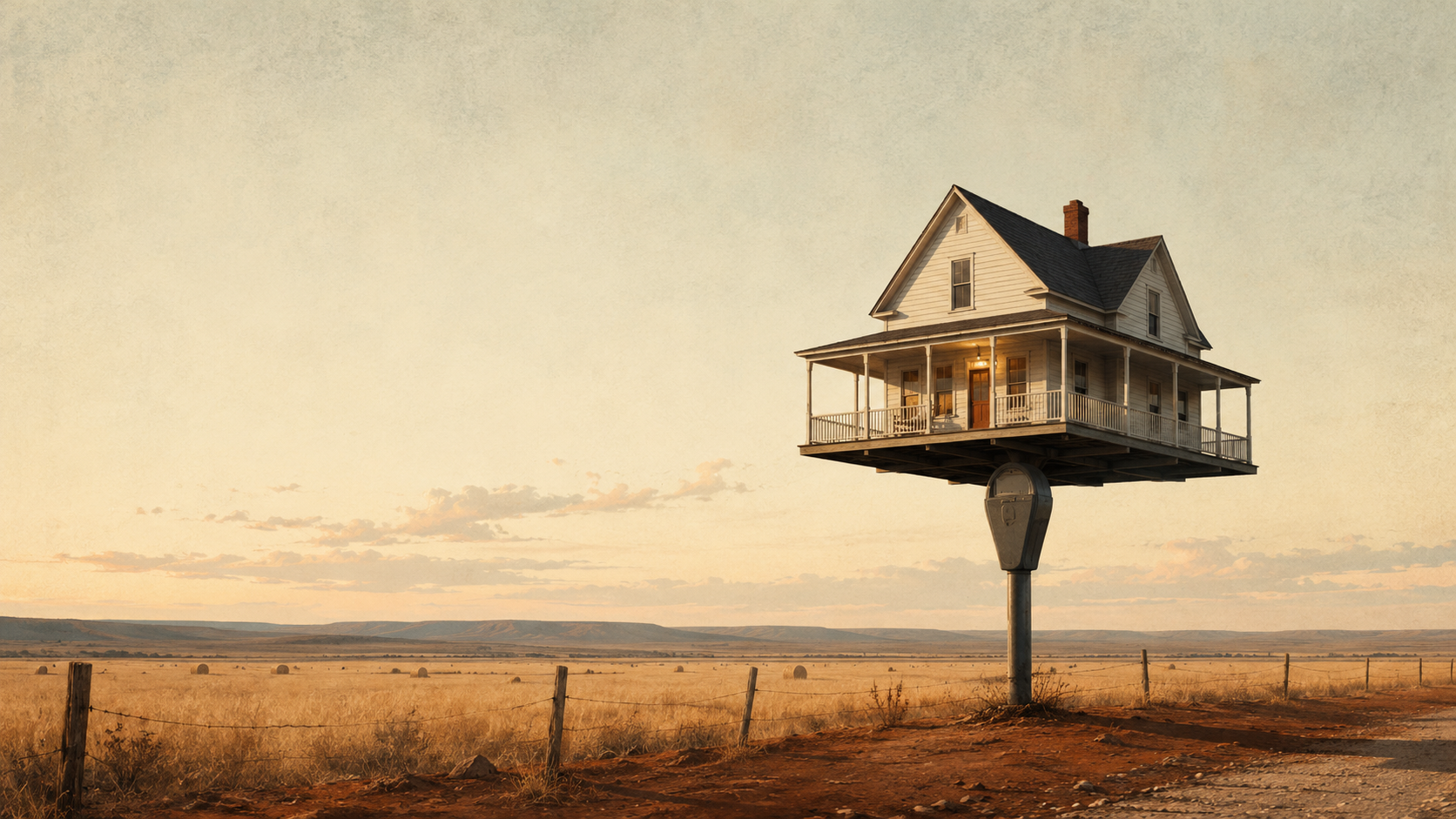
Every April, a Cooke County mailbox can sound heavier than it ought to. The wind comes across a hayfield, the gravel dust settles on the tires, and there it sits between seed catalogs and a bill from the co-op: the appraisal notice. Not a deed. Not a mortgage statement. A government guess about what your place might sell for if you were willing to leave it.
For a family with a paid-off house outside Gainesville, that piece of paper has a way of walking into the kitchen and sitting down at the table. The mortgage may be gone. The children may be grown. The porch may have been fixed with weekend labor and lumber bought after work. Still the paper comes. Still the bill follows.
We do not buy the slogan that taxation is theft. That line is too easy, and easy lines usually hide the hard truth. The road to town, the court that records a deed, the sheriff who answers a call, the schoolhouse, clean water, and the old frontier protection that many anti-secession Texans in the Red River country feared losing in 1861 were not built by one man alone. Those are common goods. They cost money. A tax that pays for them is the price of civilization, not a mugging.
Most taxes at least try to follow a moral ledger. Earn more and, in places with an income tax, pay more. Buy more taxable goods and pay more sales tax. Use fuel and pay fuel tax. We can argue rates and waste all day, and we should. But those taxes usually track money moving through your hands.
The property tax is different. It taxes having. It taxes staying. It taxes the roof after the paycheck that bought the roof has already been taxed, and it keeps taxing that roof after the mortgage note is burned.
Texans pay one of the higher property-tax rates in the country
Effective property-tax rate — tax as a share of home value, 2025.
Source: Tax Foundation; Construction Coverage analysis of Census data
Because we defend taxation when it is honest, we have to say plainly when one tax fails the test. Texas should abolish the property tax and replace it with something fairer.
Texas does not levy a state property tax. The Texas Comptroller says property taxes are local, imposed by school districts, counties, cities and special-purpose districts. That fact matters because it keeps the blame close to home, but it does not make the bill fair. Texas leans on this tax so hard partly because we have no state income tax. We are glad Texas does not have one. A state income tax would be a new hand in the paycheck. But refusing one unfair tax does not excuse clinging to another.
By the softer national estimate used in this debate, Texas' effective property-tax rate is about 1.25 percent, ninth-highest in the country, against a national average near 0.9 percent. The median Texan pays roughly $4,100 on a home worth about $313,000. That is more tax on a less valuable house than the national median homeowner faces. Pick the table and the verdict stays the same: Texans pay too much to keep what they already own.
The relief treadmill proves it. Lawmakers passed a record $18 billion property-tax cut in 2023. In 2025, Texas voters approved a higher school-district homestead exemption, from $100,000 to $140,000, with senior and disabled homeowners receiving a larger school-tax exemption package. That helps. It does not touch city and county taxes. And relief that must be re-won every session while appraisals keep climbing is bailing a boat, not fixing the hull.
Texas property-tax levy after repeated relief
Total local property taxes levied statewide, in billions of dollars.
Source: Texas Comptroller, property tax rates and levies
The cruelty is not only the size of the bill. It is the kind of bill.
A property tax is the only common tax that can put a family out of a paid-off home for the offense of staying put. Texas Tax Code Section 32.01 attaches a tax lien to property each January 1 to secure the year's taxes, penalties and interest. Fall far enough behind and the lien can lead to foreclosure. Earn nothing and an income tax can fall to nothing. Buy nothing taxable and the sales tax does not ring up. Own a roof, and the government can still come with a bill.
The tax you can stop, and the one you can't
Income and sales tax
Earn nothing and the income tax can fall to zero. Buy nothing taxable and the sales tax never rings up. These taxes follow money as it moves through your hands.
Property tax
Own your roof and the bill returns every January, even after the mortgage is burned. It is the one tax you cannot escape by changing what you do.
That is not ownership in the way people in Cooke County mean the word. It is renting your own roof for life from a stack of taxing units.
The tax also severs the bill from the cash to pay it. A widow on Social Security can see her appraisal rise because a stranger overpaid for a house down the road. A farmer can be land-rich and cash-poor while the paper value of dirt rises around him. He did not sell. He did not pocket a gain. He may be trying to keep cattle on ground that developers would rather slice into lots. Still the tax man treats a market rumor like money in the bank.
That same speculative engine is chewing at our hayfields. When outside money bids up dirt two counties over, the appraised value creeps here too. The family that stayed is punished for the buyer who arrived with cash.

The property tax also quietly spares a lot of wealth. A rich man's stock portfolio can swell while he sleeps without an appraisal notice landing in his mailbox. Fortunes held in securities, private businesses and movable assets are harder for local government to see and easier for lawyers to arrange. A middle-class family's wealth sits out in the open. It has a street address. It is illiquid. It is taxed in full view.
Then the tax punishes improvement. Fix the porch and the value rises. Add a barn, keep up fences, replace a roof before it fails, and the government can treat your thrift as taxable evidence against you. A good tax should not punish a man for making his place better.
Here is the hard part, and we should say it without blinking: abolition is not free.
Property taxes pay for schools above all. The Texas Education Agency says public school funding comes mainly from local school district property taxes, state funds and federal funds. School district rates include maintenance and operations, the day-to-day cost of running schools, and interest and sinking, the debt service for facilities and bonds. Local property taxes average around 45 percent of district revenue. Schools take the largest share of the property-tax levy, about $42 billion.
Source: Texas Comptroller; Texas Education Agency
So no, the money does not simply appear. Anyone promising to abolish the tax while keeping schools whole without a real replacement is selling wind.
The worst replacement would be a raw sales-tax blast. The Baker Institute looked at replacing all Texas property-tax revenue from 2023 with sales tax and estimated the state sales-tax rate would have to rise to 22 percent, or about 26 percent after evasion and cross-border shopping. That would be more than double Louisiana's 10.11 percent combined rate, then the nation's highest. Texas now charges 6.25 percent statewide, with local jurisdictions able to bring the combined rate to 8.25 percent.
Source: Baker Institute, Rice University
A straight sales-tax swap would hit the poor and working class too hard. Sales taxes are regressive because low-income households spend more of their income just getting through the month. We will not fix an unfair tax on the home by hammering the grocery runner, the renter, the young couple buying school shoes and tires.
The fair replacement has to move the burden off the family that stayed put and onto consumption by choice, idle land and speculation. The few, not the many.
Start with a broader consumption tax, not a sky-high sales tax on necessities. The point is to lean on what people choose to spend rather than on what they earn or simply own. Keep groceries and medicine exempt, as Texas already does for many grocery food products and over-the-counter medicines with an FDA Drug Facts panel. Add a monthly prebate up to poverty-line consumption, scaled by household size, so poor households pay nothing net on basic spending. Then tier the rest: a light touch on the everyday middle — the work truck, the washer, the school clothes — and the heaviest rate saved for true luxury, the yacht, the jet, the six-figure watch. A tax should lean on the marble counter and let the loaf of bread alone.
Tax what people choose to spend, not the roof over their heads.
Fixing the property tax is Texas's job, and the steps above and below are how. One unfairness sits outside Texas's reach, though, up in Washington, and it is worth naming because it is the same complaint we raised earlier: the property tax spares the man whose wealth moves fast and lands hardest on the family whose wealth sits still at a street address. The federal income tax could set that right and mostly doesn't. Its top bracket stops climbing at about three-quarters of a million dollars a year, so a surgeon earning $800,000 and a financier earning $80 million pay the very same top rate. Real rungs above it — steeper past a million a year, steeper still past ten million, steeper again past a hundred million, and levied where the income lands instead of where a lawyer learns to park it — would ask more of the fortunes that can bear it and less of everyone below. That is not a state income tax, and we still want none of one; it is federal money, a different pocket from the one that funds a Cooke County school. But it settles the same account: the tax we are killing spared mobile wealth, and a fair code should not.
Second, replace part of the levy with a land-value charge on the unimproved dirt, not the house, barn, fence, well or shop. A land-value tax falls on the location value of land while leaving improvements alone. Done right, it stops punishing the family that repairs the porch and starts charging the absentee holder sitting on a flippable quarter-section outside town.
This is not confiscation. The owner keeps a property right and a market buyer. If holding idle land for a future flip gets more expensive, the remedy is sale at a fair price to someone who will live on it, farm it, build on it or work it. The law should lean against speculation, not against the family in the house or the farmer using his ground.
None of this is exotic. Other countries already raise what they need without taxing a family out of its home, and they do it by choosing their ground instead of stacking one tax on top of the last. Much of Europe funds itself on a broad consumption tax that all but exempts food and medicine and leans hardest on discretionary goods — the necessity rides light, the luxury pays the freight. Estonia goes further on land than we are proposing: it taxes the ground under a building and leaves the building itself alone, so no one is punished for the house he raises on his own dirt. Denmark has taxed land values since 1902. The lesson running through all of them is not higher taxes but better-aimed ones — a swap, not a stack.
Third, phase the swap over years. Do not spring it on schools, seniors or farm families in one budget cycle. Build in a circuit-breaker tied to income. Keep strong homestead, senior, disabled and agricultural protections during the transition. Guard real working land. Pair the swap with school-finance reform that keeps classrooms funded and debt obligations honored. No local district should get sucker-punched because Austin wanted a headline.
This is where both parties like to flinch. One side talks as if every tax is tyranny, then gets quiet when the school bus needs tires. The other side talks as if every public need justifies reaching deeper into private life. We reject both habits. Government has real jobs. A man's home and labor are still his own.
The property tax violates that line. It makes permanence expensive. It turns a fixed address into a recurring liability. It lets appraisals outrun paychecks. It helps turn dirt into a casino chip. It asks the middle class to carry the weight in the most visible asset they have while wealth that moves faster slips by.
So abolish it. Do it honestly. Protect the poor. Protect the middle class. Protect schools. Put more of the burden on discretionary spending, idle land and speculation. Stop taxing the porch.
Next spring, when the mailbox claps shut on a county road outside Gainesville, the paper inside should not make a paid-off home feel borrowed. It should remind Texas that dirt may rise and markets may run wild, but a family under its own roof ought to be able to stay there.
Join the conversation
Comments