
"Snapshot, Not a Video": Sheriff Sappington Makes His Case for the Flock Cameras
In the county's first public accounting of its license plate readers, the sheriff answered a month of scrutiny with numbers, limits and an appeal to trust — and his office published the use policy and transparency portal that had not been public before. The documents support his central claims, and carry details the statement does not mention.

For more than a year, the public record of Cooke County's license plate reader program consisted of documents: two consent-agenda approvals, four payments in the county check registers, a state grant award. No public statement about the program from Sheriff Ray Sappington could be located — GvilleTX searched for one in July and said so. On Monday, the program acquired a voice.
In a two-page statement issued under his letterhead, the sheriff defended the county's Flock Safety camera program as a "force multiplier" for a small department covering a large county, described much of the online discussion about it as "incomplete, taken out of context, or simply inaccurate," and announced that his office's ALPR policy and a transparency portal "are now available." A seven-page use policy was uploaded to the county website the same day, and a Flock-hosted portal, marked "Last updated" Monday, was live with figures that GvilleTX had been unable to find anywhere in the county's public record: 16 cameras, a 30-day retention period, and a downloadable log of every search the office ran in the past month.
Sheriff Sappington's statement on the ALPR cameras
Cooke County Sheriff's Office
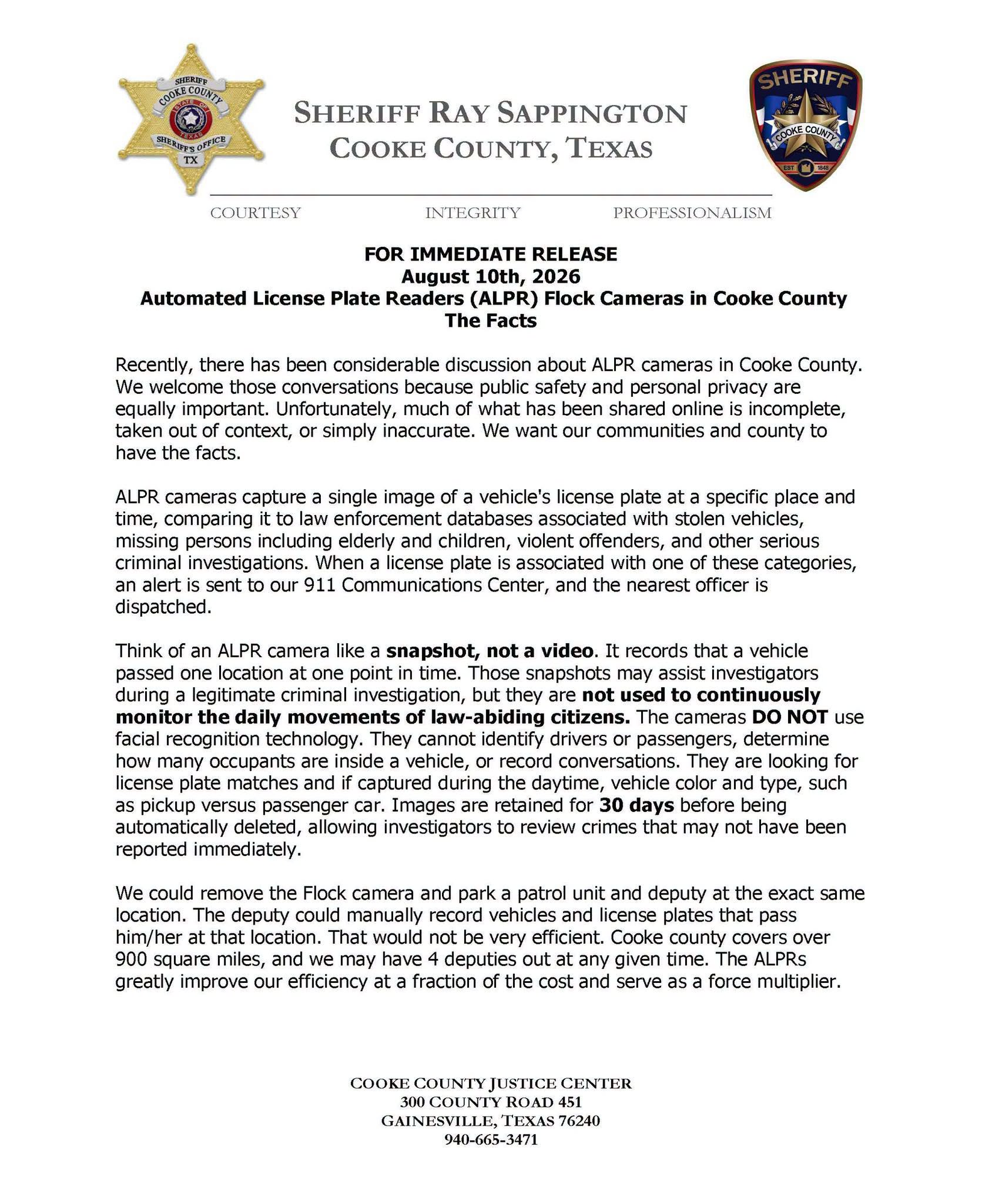
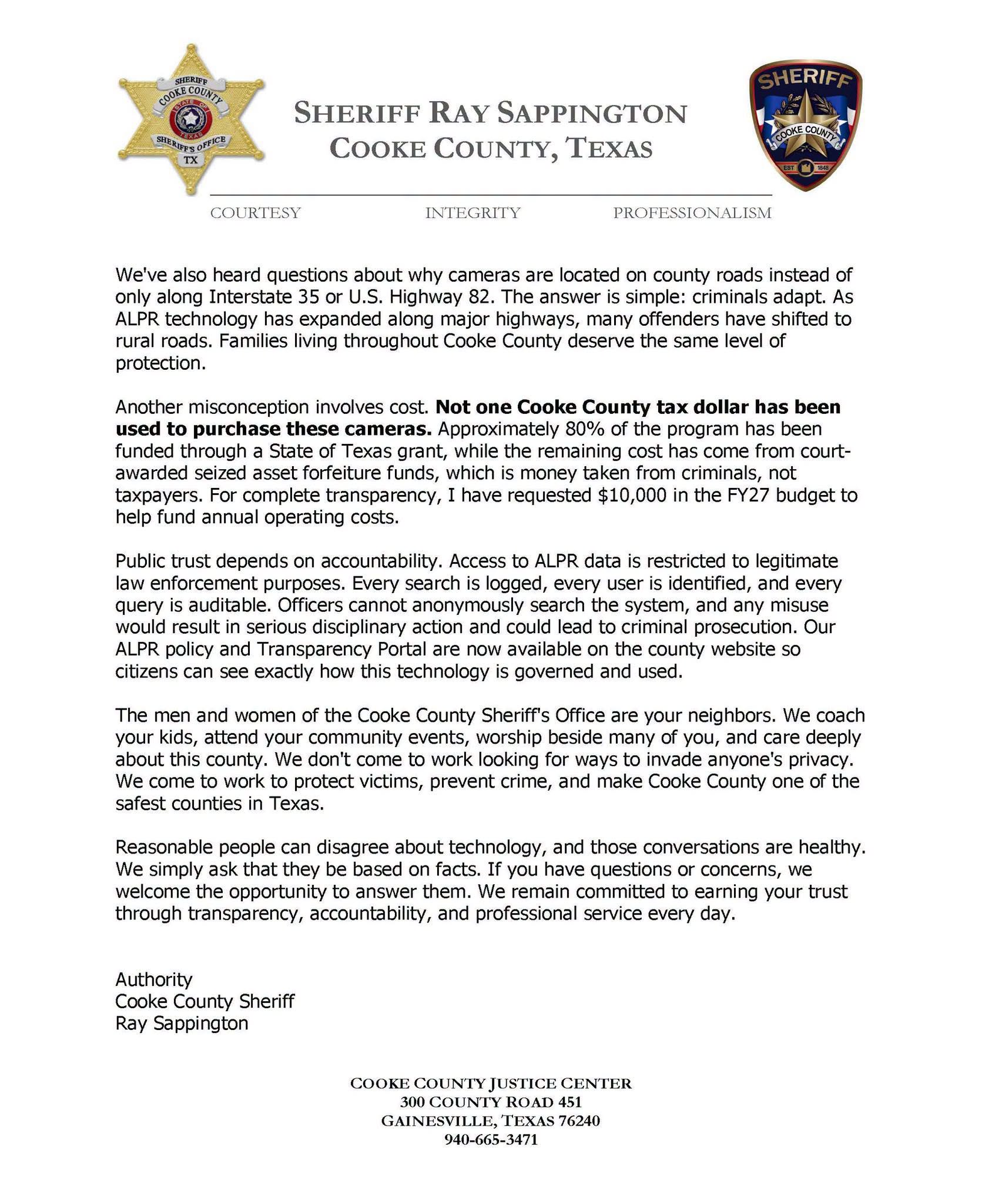
The statement, reproduced above in full, is the county's first substantive public accounting of the program that GvilleTX has been able to locate. It speaks to most of the open questions this newsroom's July reporting identified — what the cameras do, how long the data is kept, who pays — and it closes with an invitation: "If you have questions or concerns, we welcome the opportunity to answer them." Much of what it says matches the paper trail. The documents published alongside it carry details — about sharing, and about what the cameras have been searched for — that the statement itself does not mention.
What the new documents show
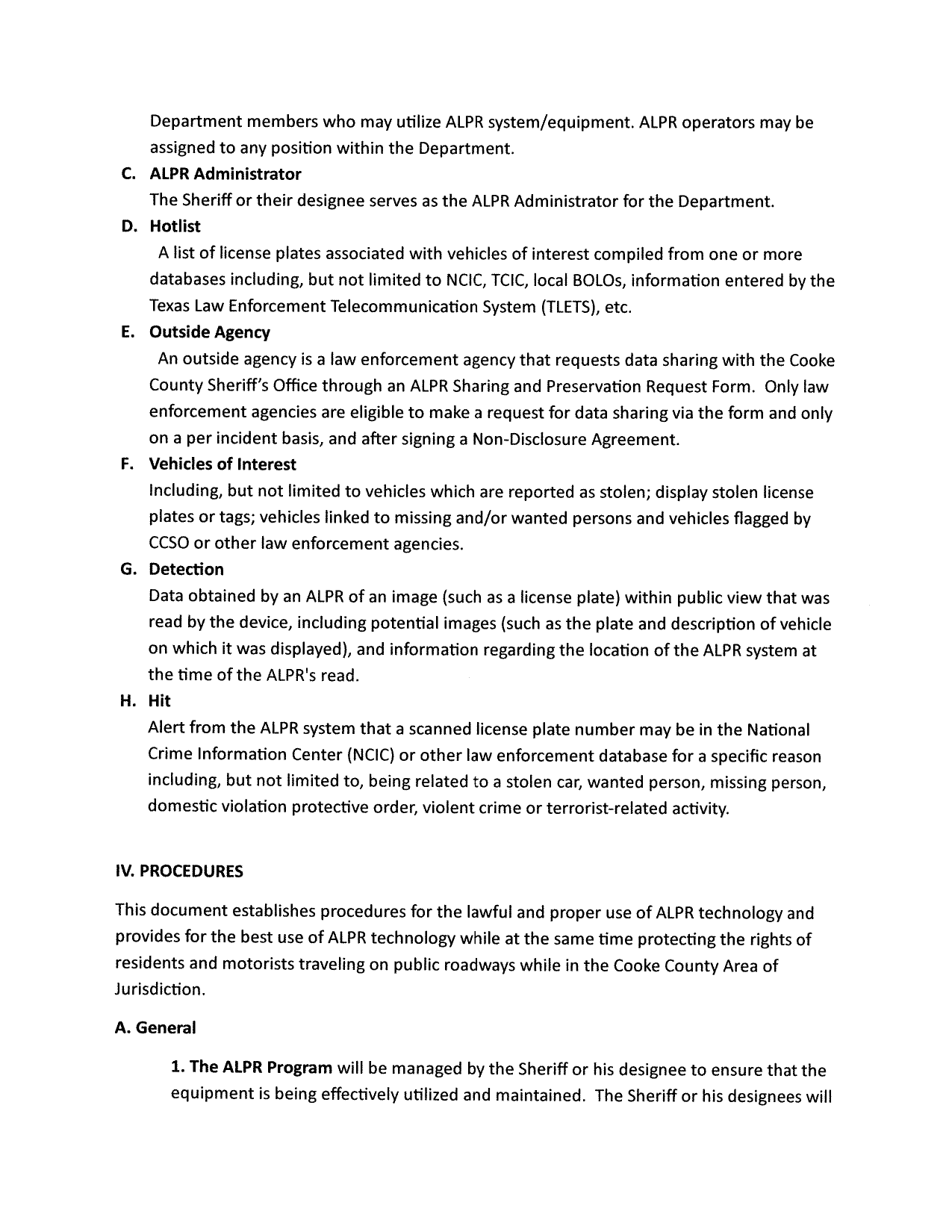
The policy the county posted Monday is dated well before Monday. Its cover sheet says Chapter 32, "ALPR / LPR Usage," took effect July 1, 2026, over the sheriff's signature. The county web server recorded the file's upload at 11:43 a.m. Monday; GvilleTX reviewed the county's site in late July and did not find it there. The file's embedded metadata records the document as digitized on July 27 and re-saved Monday morning — timestamps that describe the processing of this particular file, and that do not establish when the policy was drafted, approved or first followed inside the department.
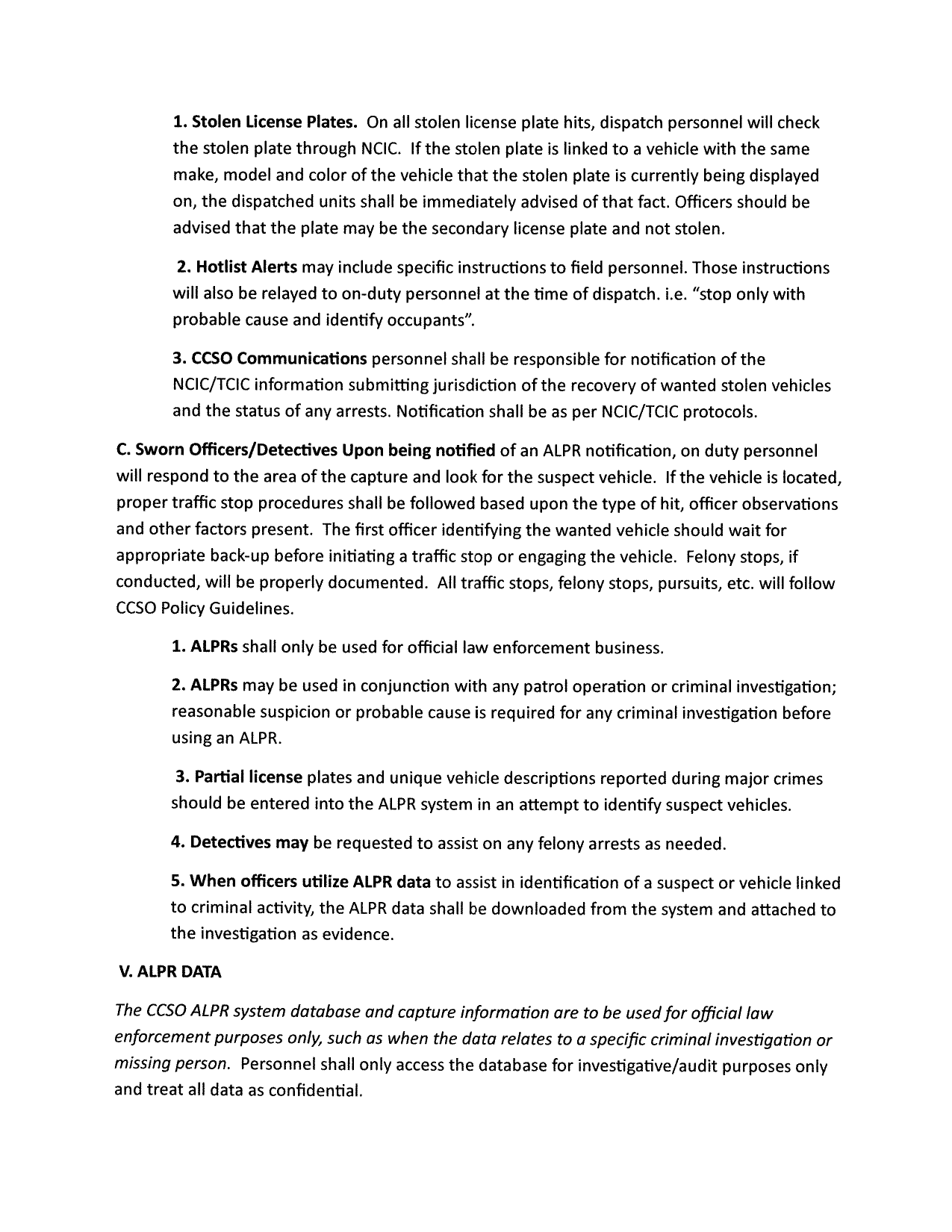
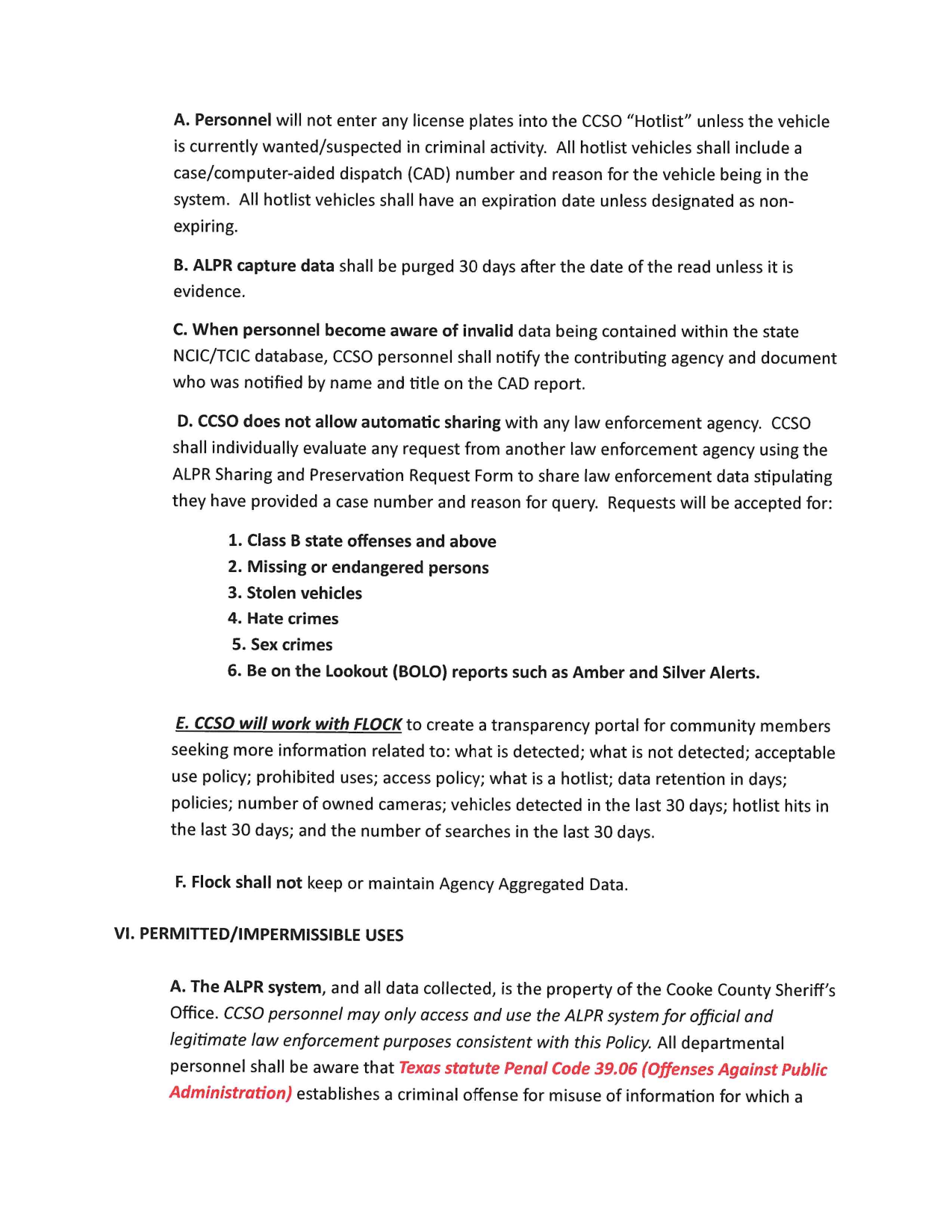
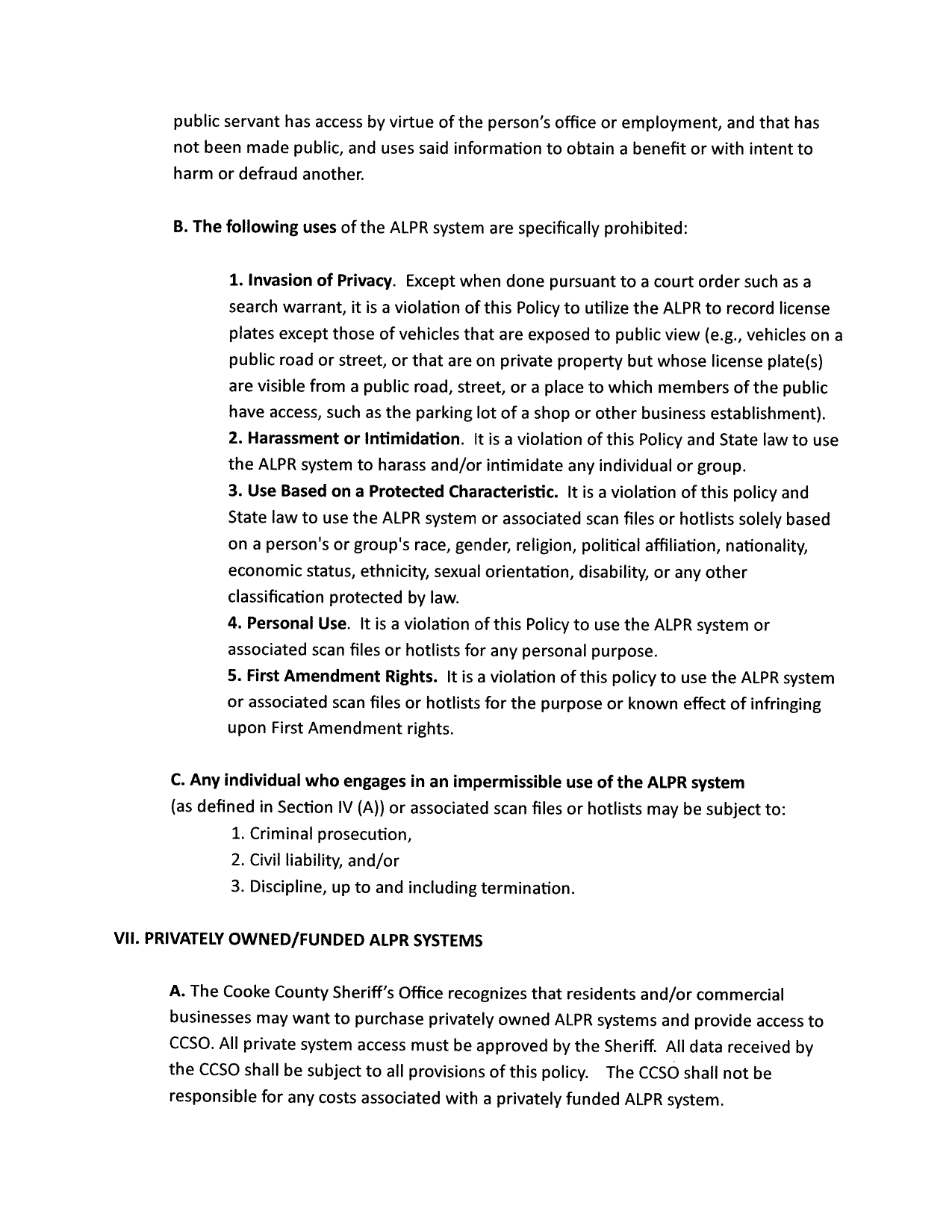
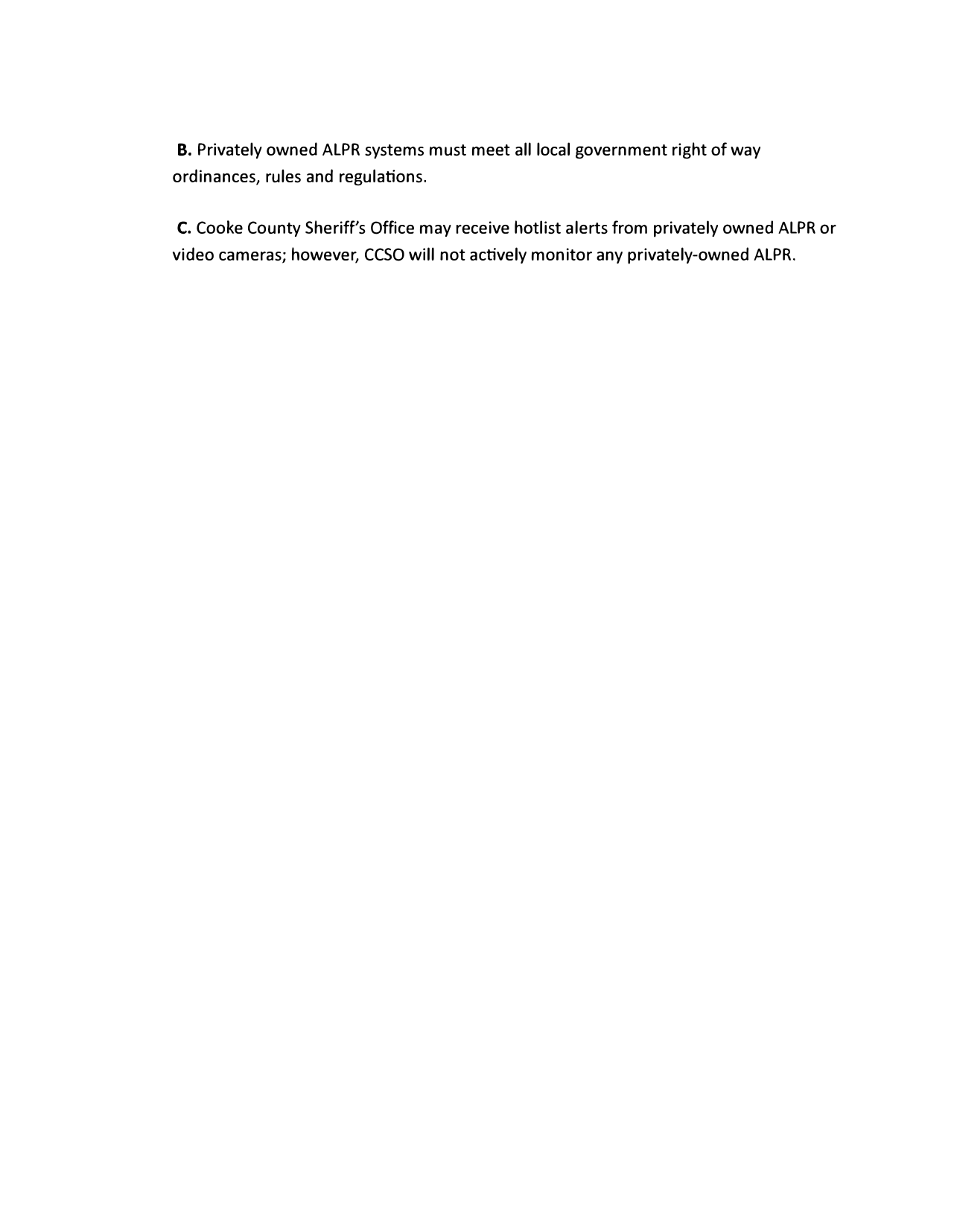
The ALPR use policy, Chapter 32
Cooke County Sheriff's Office
Original document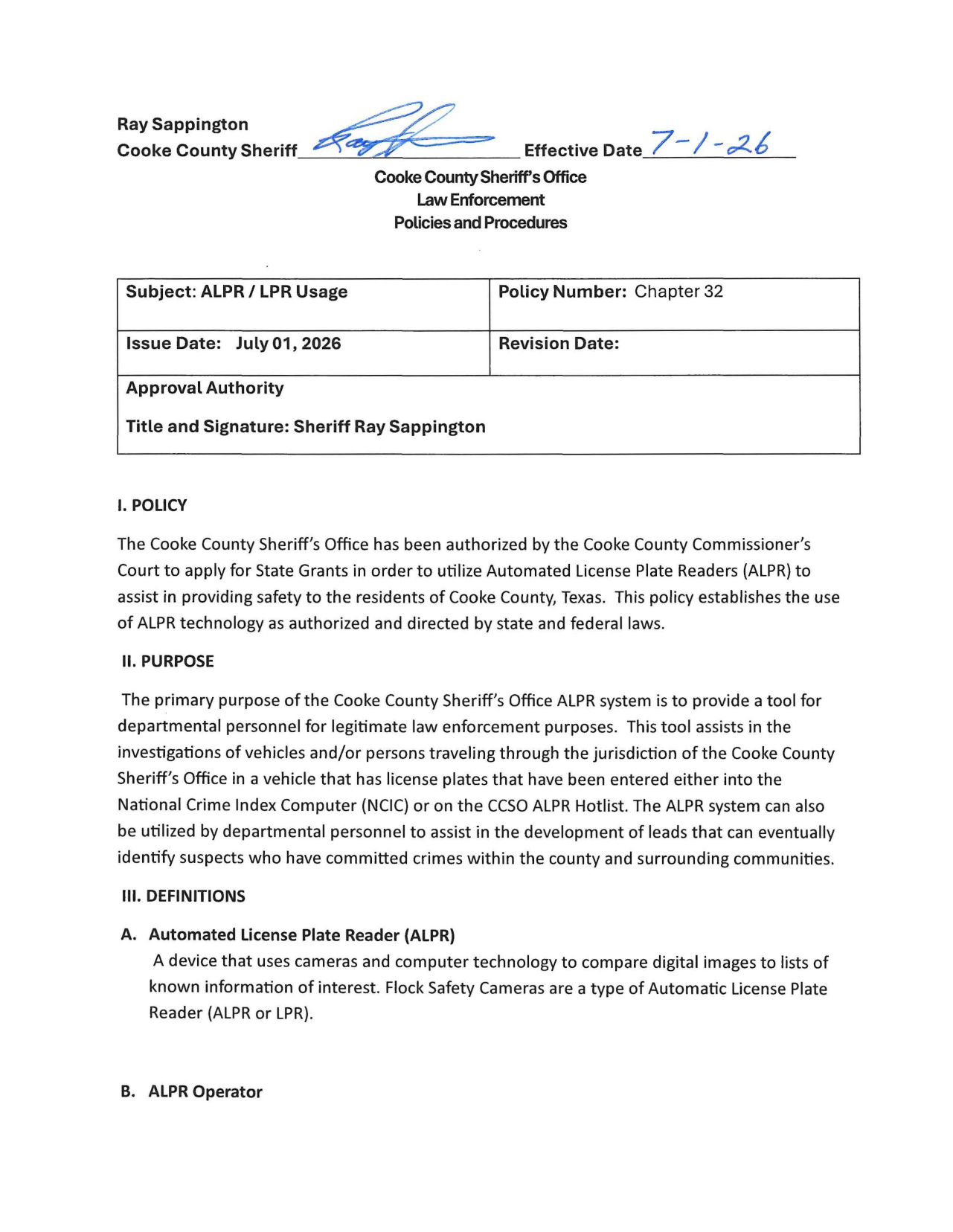
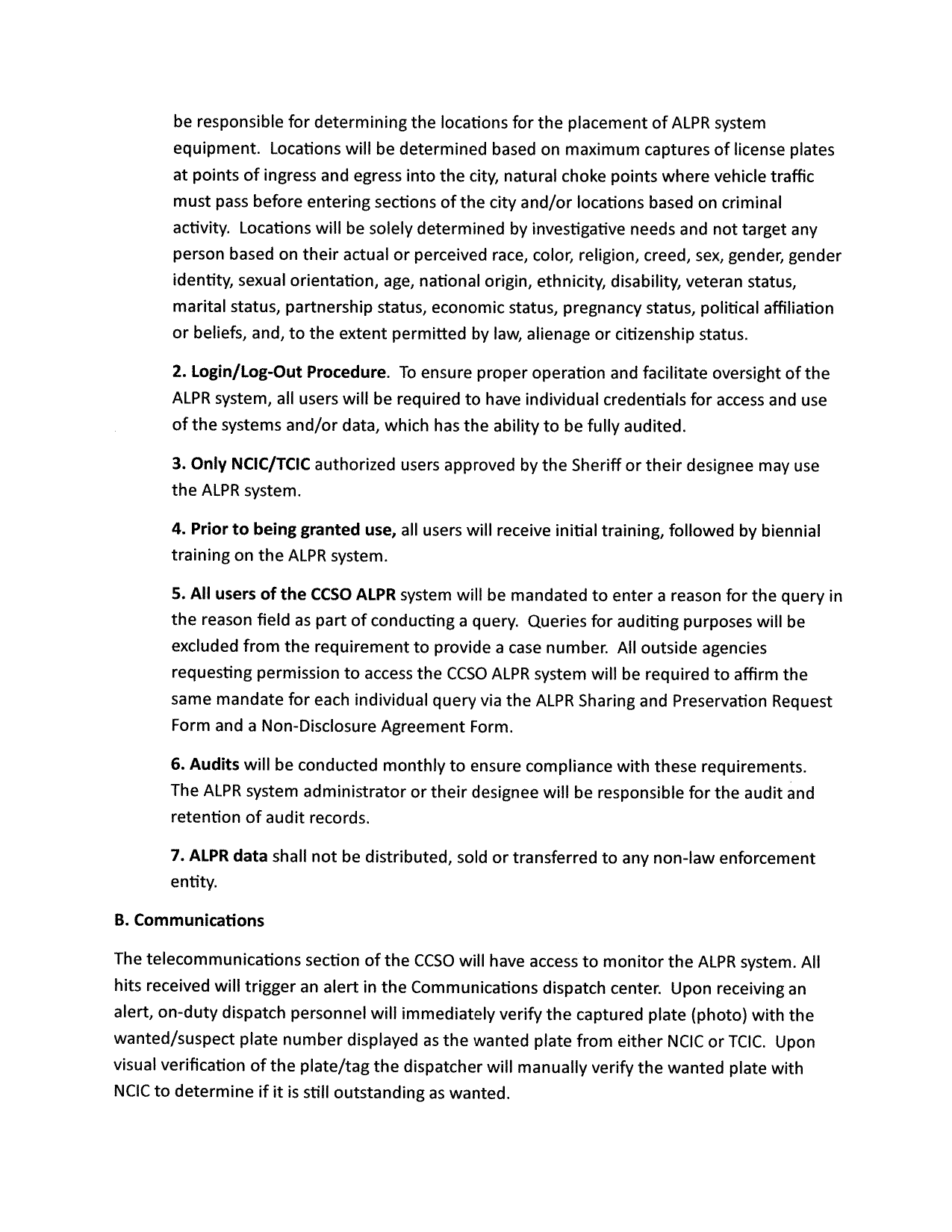
The portal's history is harder to establish. Flock's transparency pages cannot be dated through the Internet Archive's Wayback Machine, which excludes the domain, and GvilleTX could not independently establish the Cooke County page's launch date; checks of Flock's public portal pages on July 27 found none for any Cooke County agency. GvilleTX has preserved copies of the portal and its search log as they appeared Monday; its usage figures cover a rolling 30-day window and will change as days roll off.
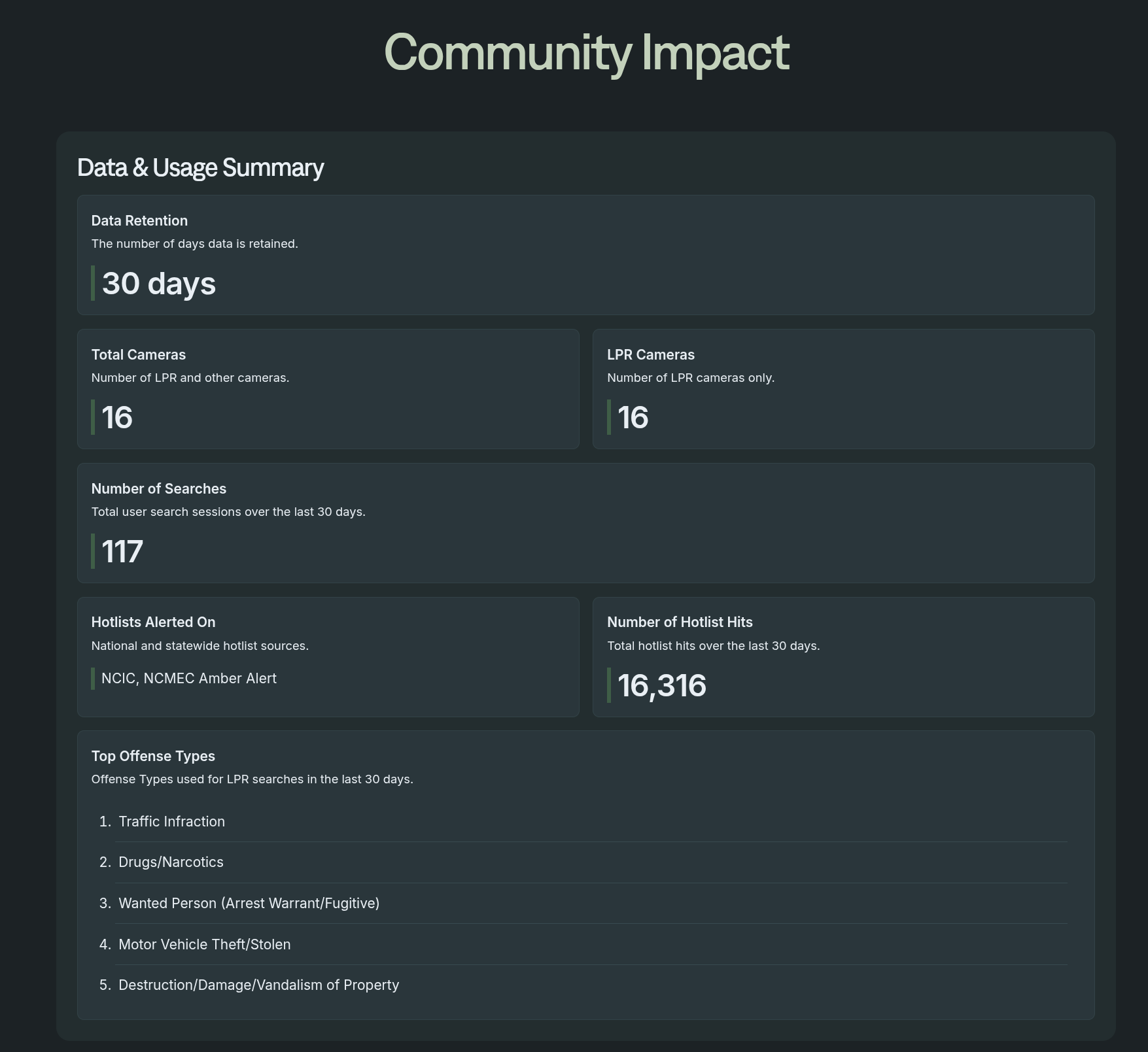
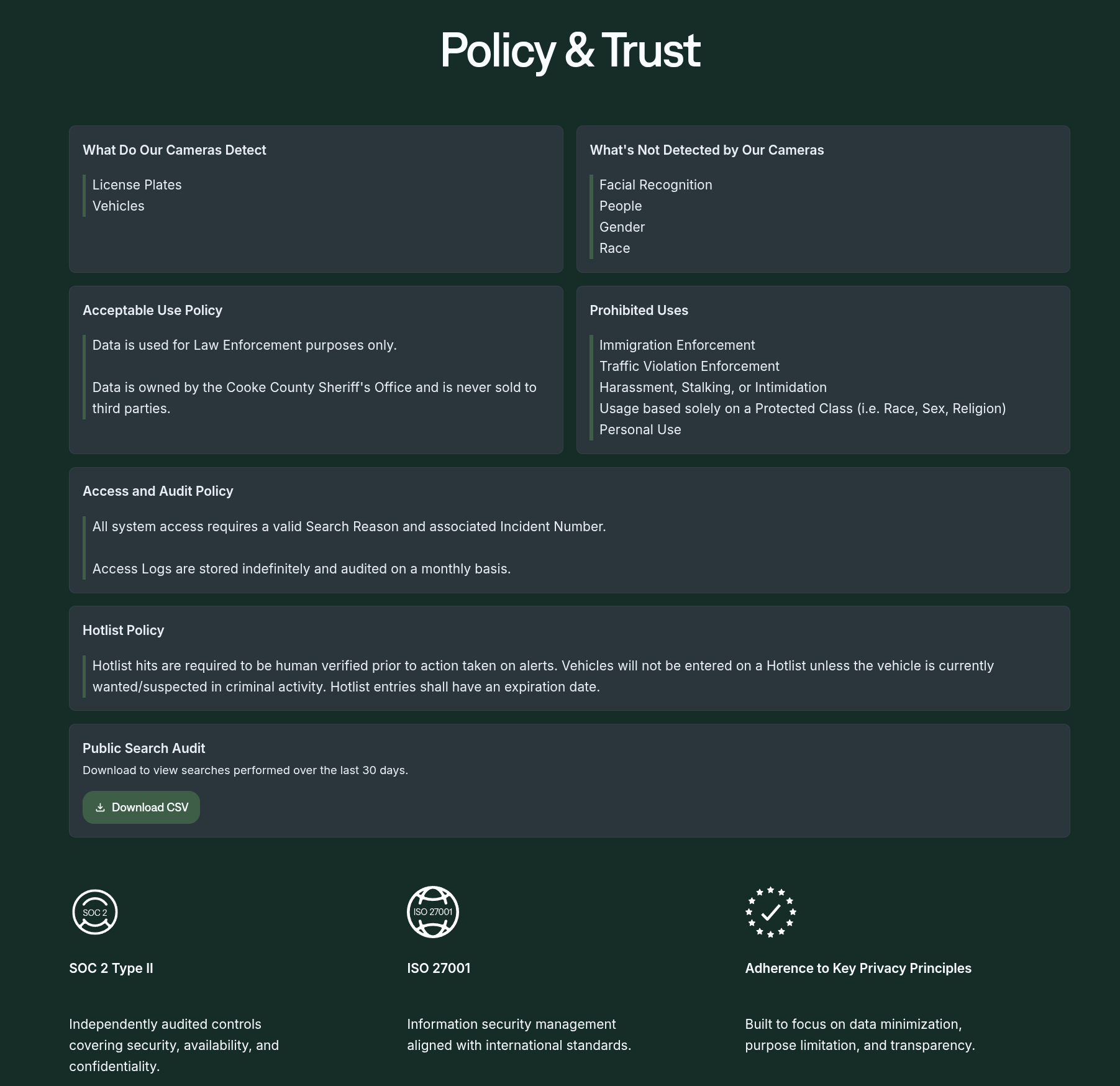
Together, the two documents supply most of what the public record lacked. The portal discloses 16 cameras, all plate readers — more than the five the petition against the program said it began with, and more than the 13 it said the county was expanding to. The portal does not say where they are. Volunteers have mapped 21 plate-reader locations in the county themselves, through OpenStreetMap and the DeFlock project, and GvilleTX has added those to its traffic and road maps — community-submitted points that are unverified and name no operating agency. The portal confirms the 30-day retention the statement describes, which the policy hardens into a rule: capture data "shall be purged 30 days after the date of the read unless it is evidence." And its acceptable-use summary adds two prohibited uses the policy itself does not name: immigration enforcement, and traffic violation enforcement. Several provisions go beyond what Texas law requires — the state has no statute governing ALPR retention or sharing. Two weeks ago, GvilleTX could locate no posted county rules to check the program's practice against. Now anyone can read them.
Inside the transparency portal
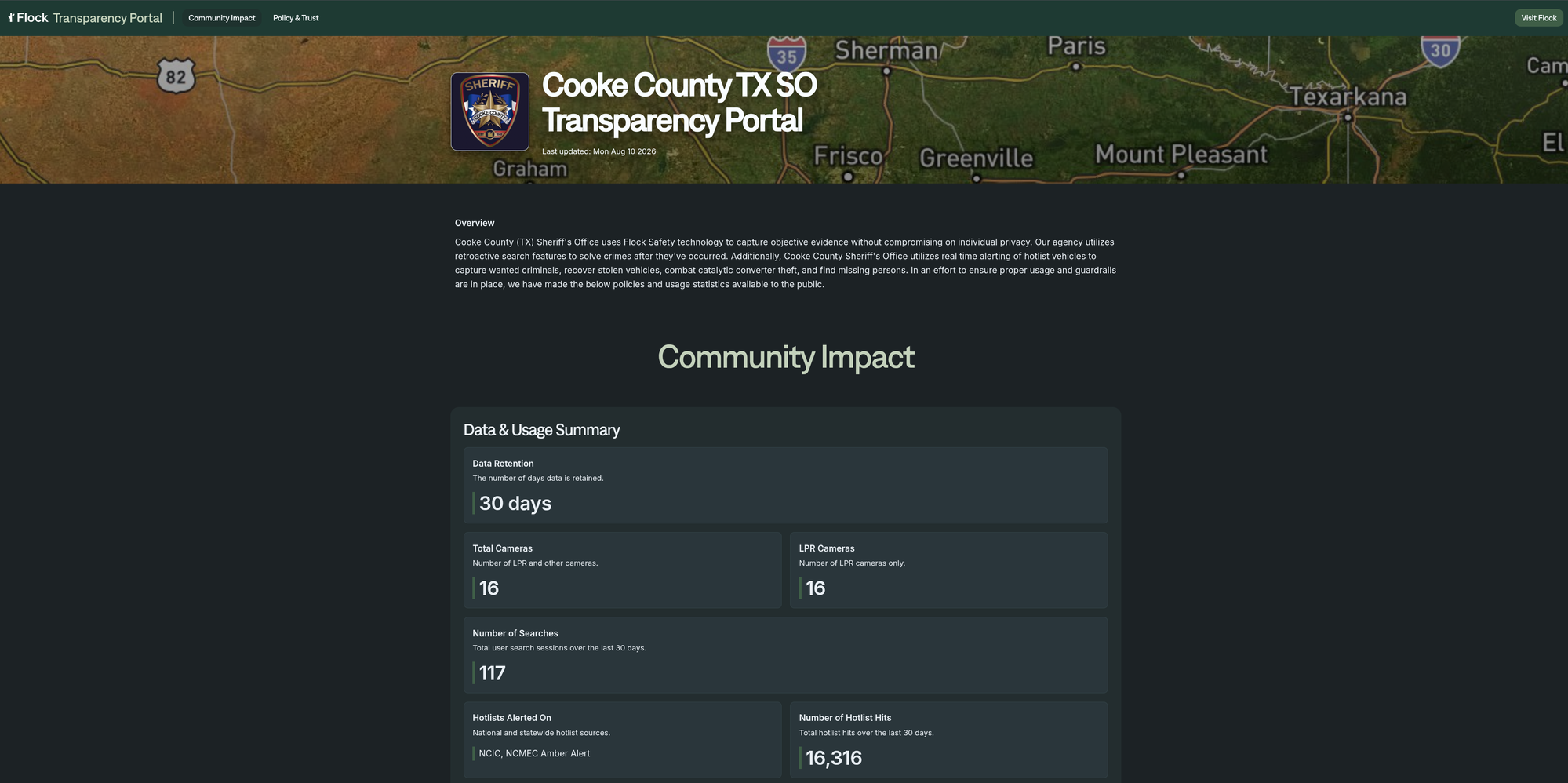
Flock Safety transparency portal, Cooke County TX SO
Original photographs- Header of the Cooke County TX SO Transparency Portal, last updated Aug. 10, 2026
The portal header: last updated Monday, Aug. 10.
- Data and usage summary: 30-day retention, 16 cameras, 117 searches, 16,316 hotlist hits
The usage summary: 16 cameras, 30-day retention, 117 searches and 16,316 hotlist hits in 30 days.
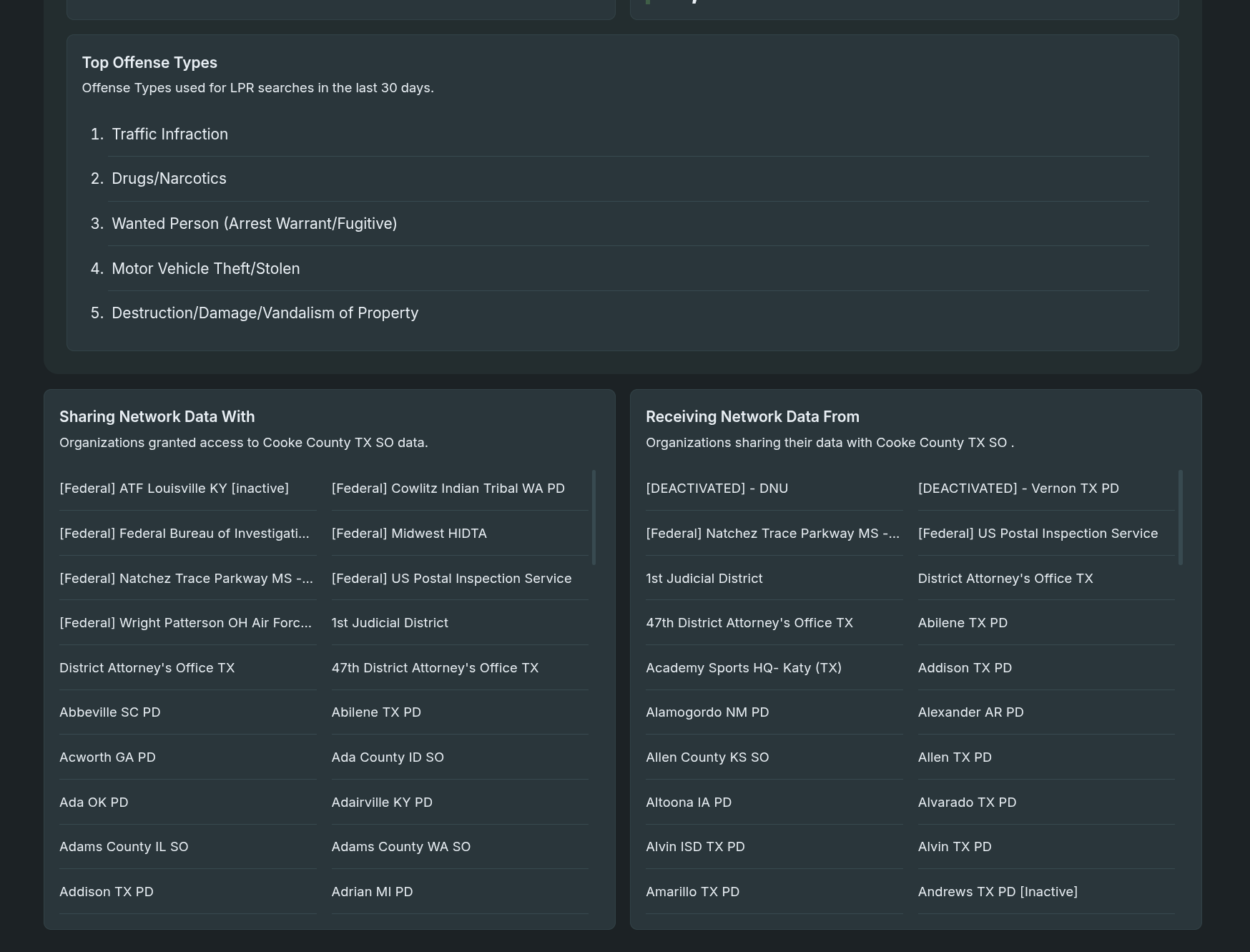
- Sharing Network Data With and Receiving Network Data From lists, including federal entries
The sharing rosters: 1,382 organizations granted access to county data, federal agencies among them.
- Policy and Trust section listing prohibited uses including traffic violation enforcement
The acceptable-use summary. "Traffic Violation Enforcement" is listed among prohibited uses.
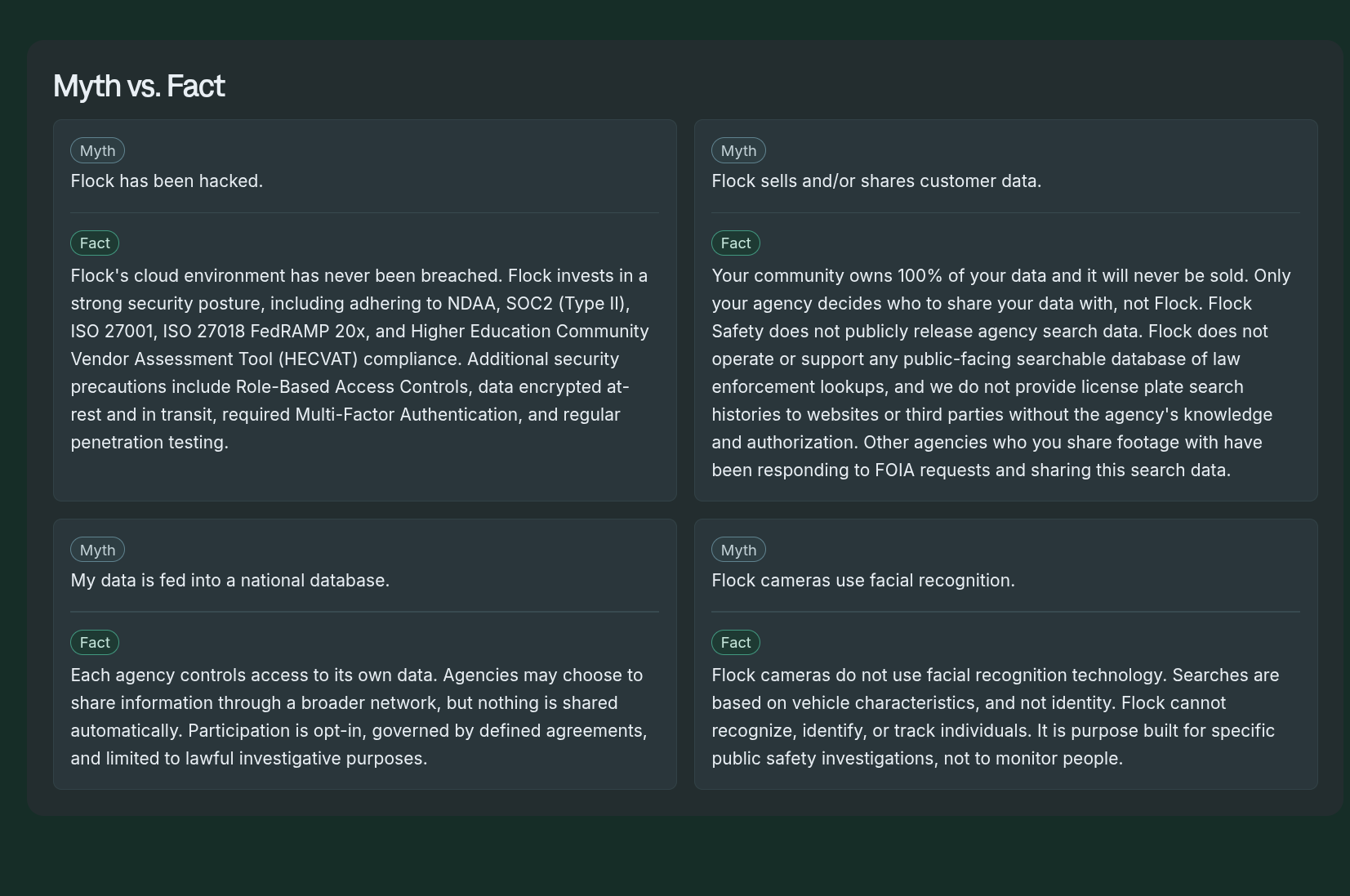
- Flock's Myth vs. Fact panel on the portal
A "Myth vs. Fact" section, supplied by Flock, closes the page.
The ledger and the eighty percent
The statement's funding breakdown — "approximately 80%" from a State of Texas grant, the rest from forfeiture funds, "not one Cooke County tax dollar" — sits close to the county's own books. Of the $83,550 in Flock payments GvilleTX traced through the check registers in July, $66,781 — 79.9 percent — moved through a single expense account, and $12,993, about 16 percent, came from the sheriff's drug-forfeiture fund. The registers record only which accounts payments were charged to, not where the money originated, so they neither confirm nor contradict the sheriff's account of where it came from; a further $3,776 was coded to two general-fund equipment accounts.
The Flock payments in the county's check registers
Cooke County weekly check registers
- June 23, 2025 check register lines: FLOCK SAFETY LPR FLEX, $376.00 and $3,874.00
June 23, 2025: $4,250 — "FLOCK SAFETY LPR FLEX," split between an equipment account and the forfeiture fund.
- January 12, 2026 check register lines: FLOCK SAFETY LONG-RANGE, $20,700.00 on account 001-560-460 RENT
Jan. 12, 2026: $24,100 — "FLOCK SAFETY LONG-RANGE," $20,700 of it on account 001-560-460, "RENT."
- March 23, 2026 check register line: FLOCK SAFETY LONG RANGE, $24,000.00 on account 001-560-460 RENT
March 23, 2026: $24,000 — again on the rent account.
- April 27, 2026 check register lines: FLOCK SAFETY BUNDLE, $22,081.00 and $9,119.00
April 27, 2026: $31,200 — "FLOCK SAFETY BUNDLE," split between the rent account and the forfeiture fund.




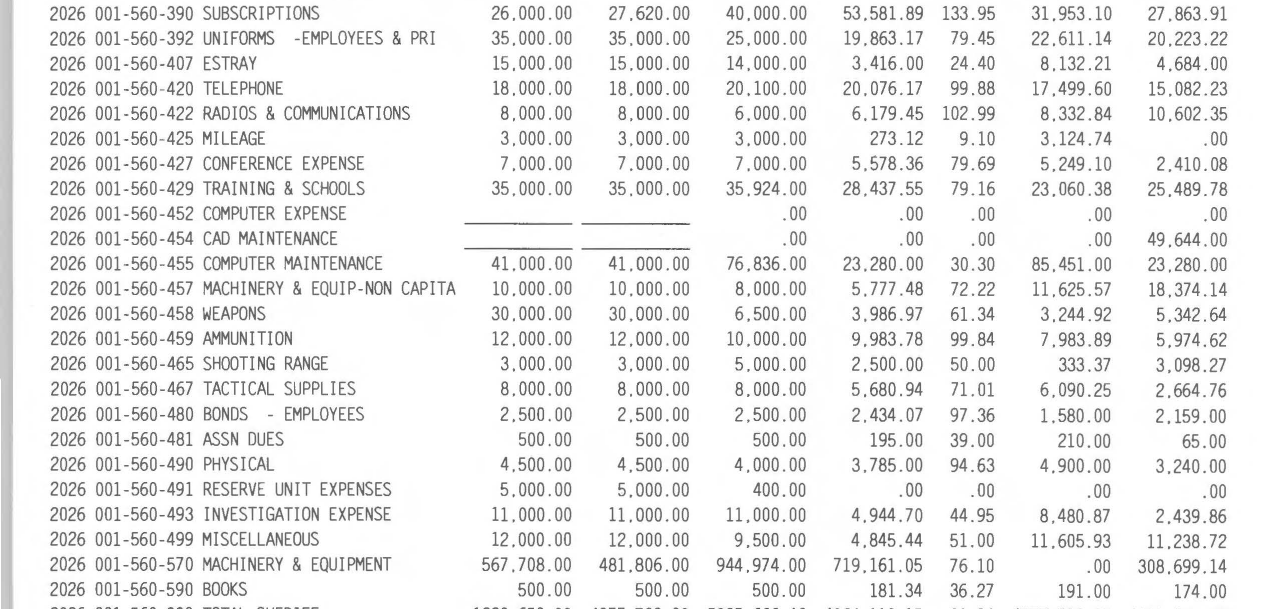
One question the statement does not take up is the account those payments ran through. Account 001-560-460, written in the registers as "RENT," does not appear in the sheriff's department budget as adopted — a line-by-line review of the county's adopted fiscal 2026 budget, repeated for this article, finds the department's accounts running from 458 (weapons) to 459 (ammunition) and then to 465 (shooting range). Which budget action created the account, and when the commissioners court approved it, is not in the records GvilleTX has reviewed.
State law defines where each stream originates. The Motor Vehicle Crime Prevention Authority, the state body that awarded the sheriff's office its grants, draws its money from part of a $5 fee the state charges auto insurers for each motor vehicle year of insurance: under Chapter 1006 of the Transportation Code, $1 of every fee is set aside for catalytic-converter enforcement, and the authority is appropriated 20 percent of what remains, with the rest going to other criminal-justice purposes and to trauma care. A Texas Department of Insurance rule permits insurers to recoup the fee from policyholders, though it does not require them to. Forfeiture proceeds become public funds once a court awards them: Chapter 59 of the Code of Criminal Procedure restricts them to law-enforcement purposes, requires the agency to file a spending budget with the commissioners court, and bars that court from cutting the agency's regular funding because an award was made. They pay for equipment without a direct charge to residents.
The account that is not in the budget
Cooke County adopted FY2026 budget
Original photographs- Excerpt of the adopted FY2026 Cooke County budget showing sheriff's department accounts jumping from 001-560-459 to 001-560-465 with no 460
The sheriff's accounts run 458, 459, then 465. There is no 460.
The $10,000 the sheriff says he has requested for fiscal 2027 would, if adopted, put the program in a county budget under its own name for the first time in the records GvilleTX has reviewed. The county paid Flock $79,300 in fiscal 2026. What it would owe in future years, and on what renewal terms, would be answered by the executed contract, which remains unpublished.
1,382 organizations, and the sharing rules
On sharing, the statement says access "is restricted to legitimate law enforcement purposes." The policy goes considerably further: the sheriff's office "does not allow automatic sharing with any law enforcement agency," and outside agencies must request data "on a per incident basis," by form, with a case number and a signed non-disclosure agreement. The portal, meanwhile, lists 1,382 organizations under "granted access to Cooke County TX SO data" — from neighboring departments in Denton, Sherman and Lindsay to agencies in more than 30 states, with seven federal entries among them, including the FBI, the U.S. Postal Inspection Service and an ATF office marked inactive. Another 854 entries share data back to the county, including private camera owners — Home Depot, Lowe's, several homeowners' associations — whose participation the policy separately provides for. The rosters show configured sharing relationships, not documented instances of access.
The county's own searches reach outward at scale: in the portal's downloadable audit, a "networkCount" field — which appears to record how many Flock networks a search reached — exceeded 1,000 in 97 of the 117 searches logged. Neither document explains how the policy's per-incident, form-and-NDA rule relates to a standing roster of 1,382 organizations. It may be that the roster reflects the Flock network's mutual opt-in while the form governs requests outside it; the documents do not say, and the answer determines what "restricted" means in practice.
What the county searched for
The search log the county published is its most detailed disclosure. It records 117 searches by sheriff's office staff between July 12 and Aug. 8, each with a reason. The most common was "Wanted Person," logged 27 times. The second was "Traffic Infraction," logged 18 times. The same portal lists "Traffic Violation Enforcement" among the program's prohibited uses.
What Cooke County searched the cameras for
The chart loads when visible. All values are in the table.
Cooke County Sheriff's Office Flock transparency portal, public search audit, accessed Aug. 10, 2026
The portal separately lists traffic violation enforcement as a prohibited use; the log does not show what these searches involved
View as a table
| Label | Value |
|---|---|
| Wanted person | 27 searches |
| Traffic infraction | 18 searches |
| Drugs/narcotics | 17 searches |
| Stolen vehicle | 15 searches |
| Vandalism/property damage | 11 searches |
| Burglary | 5 searches |
| All other reasons | 24 searches |
The two labels are not identical, and the log records only the reason category — not the case behind a search, what it returned, or how it was used. It cannot show whether any search was used to enforce a traffic violation; offenses such as fleeing police and reckless driving appear under their own labels, and one search was logged as "City Planning/Traffic Analysis." The policy requires reasonable suspicion or probable cause before the system is used in a criminal investigation, and requires monthly audits; whether these searches comply cannot be determined from the public log.
One more figure in the portal is undefined there: 16,316 "hotlist hits" in 30 days, roughly 540 a day across 16 cameras — against 117 staff searches in the same window. The statement describes a hit as something that alerts the 911 center and dispatches the nearest officer; the records do not establish whether the portal's "hotlist hit" means the same thing.
What the statement does not address
The statement describes much of the online discussion as inaccurate but does not identify a specific claim it disputes. Nothing in the newly published documents contradicts the facts previously reported from county records — the payments, the account codings, the consent-agenda approvals; those rest on the registers and agendas, not on the new documents. The statement does not address the rent account, the executed contract, or where the 16 cameras stand. And it addresses only the cameras: it does not mention the county's separate subscriptions to Aware Inc., a biometrics company, recorded in the ledger as "FACIAL RECOGNITION SUBSC" — $33,570 across three fiscal years, as GvilleTX has reported, with no published policy GvilleTX has located.
The statement's own answer to the privacy question is that the cameras are "not used to continuously monitor the daily movements of law-abiding citizens." Whether assurances of that kind answer the objection is a long-running argument in law reviews and in court. Daniel J. Solove, a law professor at George Washington University, examined its most familiar form — that people with nothing to hide have nothing to fear — in a 2007 San Diego Law Review article, "I've Got Nothing to Hide" and Other Misunderstandings of Privacy, arguing that the framing treats privacy as the concealment of wrongdoing and so leaves out harms such as error, aggregation, and a lack of transparency and accountability. Edward Snowden, the former National Security Agency contractor, put a version of the counter-argument in a 2015 interview with The Guardian: "When you say I don't care about the right to privacy because I have nothing to hide, that is no different than saying I don't care about freedom of speech because I have nothing to say or freedom of the press because I have nothing to write."
The statement arrives amid organized local pressure: the removal petition launched July 26 had 44 signatures by Aug. 6, its author has published a running series of records-based posts, and a Facebook page dedicated to scrutiny of the cameras appeared the same week. The debate is not only local — KTEN reported in July that Texarkana residents asked their city council to disable that city's cameras, and the leading federal court challenge to a Flock network, in which a judge granted summary judgment to the city of Norfolk, Va., in January, is now on appeal.
Two weeks ago, the program's rules could not be checked against its practice, because no rules were public. Now the policy is posted, the portal is live, and the search log can be downloaded by anyone. "If you have questions or concerns," the sheriff's statement says, "we welcome the opportunity to answer them."
Methods note: This article draws on the Cooke County Sheriff's Office statement of Aug. 10, 2026, reproduced above; the ALPR policy and Flock transparency portal published the same day, copies of which GvilleTX has preserved; county check registers and the adopted FY2026 budget; and prior GvilleTX reporting linked in the text. Document images are unaltered excerpts; each links to or cites its original. Figures attributed to the portal reflect its contents as of Aug. 10; its usage statistics cover a rolling 30-day window. GvilleTX has not sought comment from county officials for this article; where the record is silent, the article says so.
Join the conversation